 EN
EN  العربية
  Български
  Čeština
  Dansk
Dansk  Deutsch
  Ελληνικά
  Español
  Suomi
Suomi  Français
  עברית
עברית  हिन्दी
  Bahasa Indonesia
  Italiano
  日本語
日本語  한국어
한국어  Bahasa Melayu
  Nederlands
  Norsk
Norsk  Polski
  Português
  Română
  Русский
  Svenska
  Kiswahili
  ไทย
ไทย  Türkçe
  Українська
  Tiếng Việt
  中文
中文 The Farmers Market Table That Became a Regional Wholesale Account
By Ingrid Sorensen, Specialty Food Producer — Madison, WI
I started selling at the Dane County Farmers Market in 2019 — small-batch preserves, pickles, and fermented foods under the name Northfield Provisions. My Saturday table was doing $1,100 to $1,400 depending on the season. I had regulars. I had a waiting list for my fermented hot sauce. I had a business card with a hand-drawn jar on it.
In March 2020, a specialty grocery buyer from a regional co-op chain stopped at my table. She bought two jars of my sauerkraut and a jar of my habanero honey. She handed me her card and said they were always looking for local producers. Their stores carried over 600 specialty food items. Their typical wholesale order was 24 units per SKU per location across 8 stores.
I did the math on the drive home. 24 units × 8 stores × 6 SKUs at my wholesale rate was roughly $6,048 per order. They reordered quarterly.
I had no wholesale pricing structure, no invoice template with a PO field, no way to track which stores had placed which orders, and no idea what a co-op wholesale agreement looked like. I had a spreadsheet and a prayer.
I called her the next day and said I was working on getting my wholesale materials together. I spent the next two weeks building the invoice structure before I replied.
The Invoice That Unlocked the Account
The co-op’s accounts payable ran on net-30 with PO numbers. They needed a formal invoice, not an email receipt. Their buyers needed to see product codes, unit prices, case quantities, and delivery terms.
Here’s what I built in InvoiceFlow:
Wholesale Order — Northfield Provisions — [Co-op Name] — [Date]:
Account Details:
- Account: [Co-op name] | Account #: [####]
- Buyer contact: [Name, email]
- PO Number: [PO-####]
- Resale certificate: On file | Cert #: [####]
- Delivery: [Location address] | [Date]
Items:
- Fermented Sauerkraut (16oz) — SKU NP-001 | Case qty: 12 | Unit price: $4.25 | Extended: $51.00
- Spicy Kimchi (16oz) — SKU NP-002 | Case qty: 12 | Unit price: $4.75 | Extended: $57.00
- Habanero Honey (8oz) — SKU NP-004 | Case qty: 12 | Unit price: $5.50 | Extended: $66.00
- Subtotal: $174.00 per location
- 8 locations × $174.00 = $1,392.00
- Delivery: Included (consolidated delivery to distribution center)
- Order total: $1,392.00
Payment Terms: Net-30 Minimum order: 12 units per SKU per location Reorder cycle: Quarterly
They approved the first order inside a week. The PO came through on a Tuesday; I had $1,392 invoiced and delivery scheduled by Thursday.
Building the Full Wholesale Structure
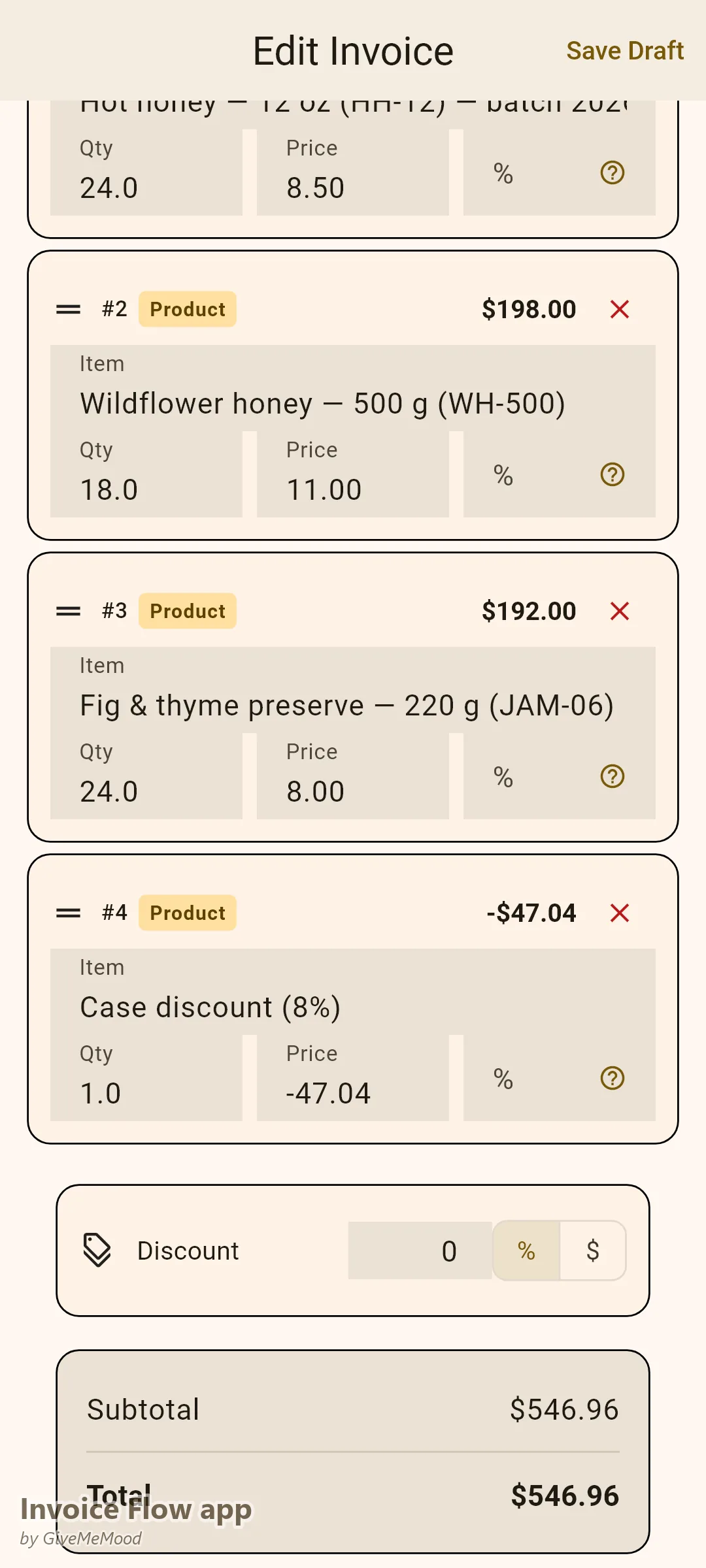
The co-op account forced me to build what I should have had from the beginning: a real wholesale pricing structure and a separate template for each account type.
My pricing tiers:
- Farmers market / direct retail: full price ($9.50–$14.00 retail)
- Specialty retail wholesale (co-ops, independent grocers): 42–45% off retail
- Distributor / regional accounts (large volume): 50–55% off retail
- Restaurant and food service (low volume, specialty use): 35–40% off retail
I built a separate InvoiceFlow template for each tier with the correct pricing pre-loaded. When a new specialty grocer called, I opened the retail wholesale template, filled in their account details, and the pricing was already right.
Farmers Market Invoices
Direct sales at the market were simple, but I started issuing receipts after a wholesale buyer at the table asked for documentation of their purchase.
Farmers Market Sale — Northfield Provisions — [Date]:
- Event: Dane County Farmers Market
- Items:
- Total: $[total]
- Payment: [Cash / Card / Venmo]
- Note: Batch code [####] | Produced [date] | Best by [date]
The batch code and production date turned out to matter: one of my co-op buyers used them to track shelf life and reduce spoilage in their inventory system. It made me look professional. It also saved me when a store once claimed they’d received product close to expiration — I could pull the invoice and show the production and delivery dates.
Restaurant and Food Service Accounts
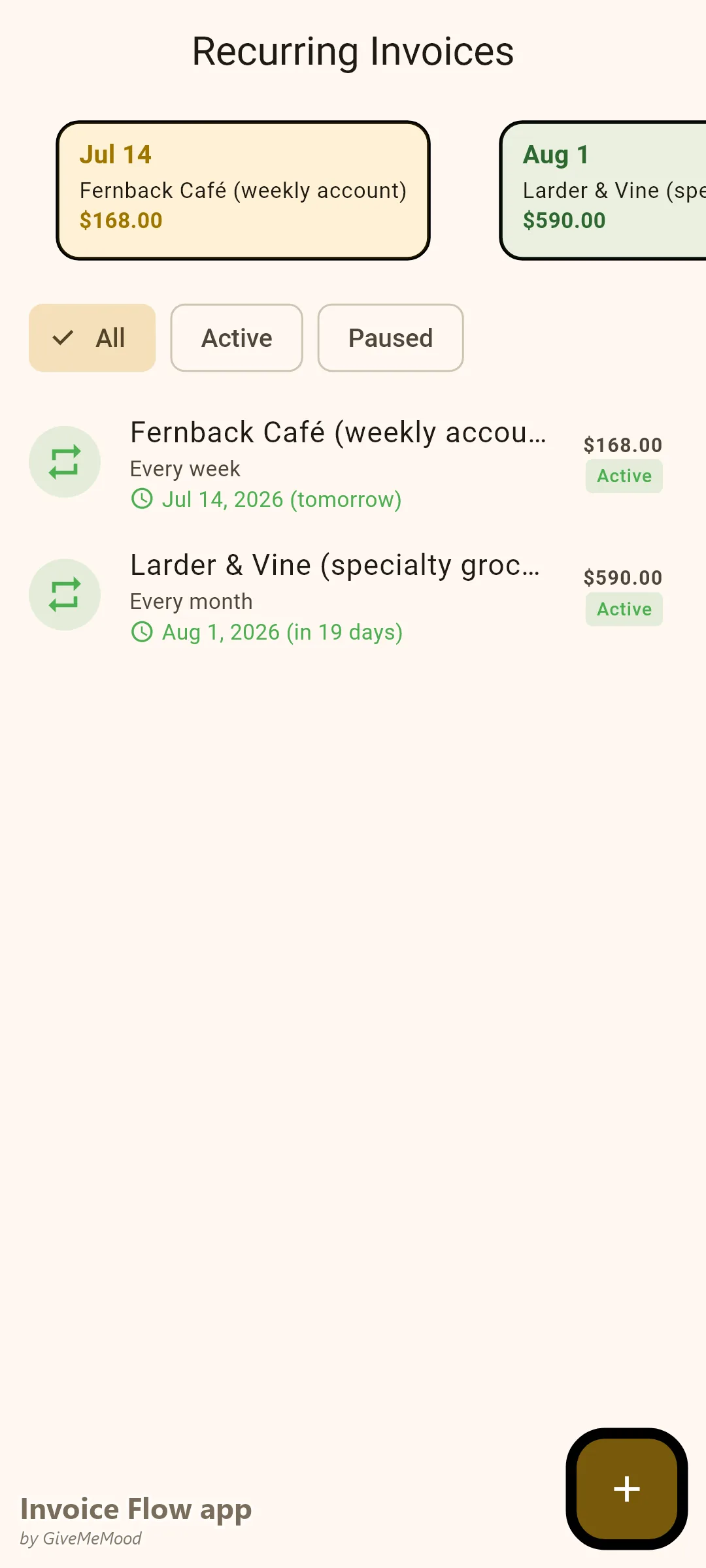
Two farm-to-table restaurants in Madison started ordering after a chef found me at the market. Restaurant accounts are different from retail wholesale — they’re using my products in dishes, not reselling them. Smaller volumes, tighter margins on their end, and they want flexibility.
Food Service Order — [Restaurant Name] — [Date]:
- Account: [Restaurant name] | Contact: [Chef/manager name]
- Account type: Food service (not for resale)
- PO Number: [PO-####] (or verbal authorization if small order)
Items:
- [Product] — [SKU] | Qty: [N] | Food service price: $[rate] | Extended: $[total]
- Order total: $[total]
- Payment Terms: Net-15 (established accounts) / Due on delivery (new accounts)
- Delivery: [Date] | Driver: [Name or self-delivery]
Restaurant accounts pay faster than retail accounts because they order closer to their actual need. A grocery co-op plans quarters ahead; a restaurant calls when they’re running low. I keep restaurant terms at net-15 because the urgency of their ordering cycle means they actually pay promptly.
Subscription and CSA-Style Programs
After three years at the market, I had regulars who wanted guaranteed access to limited-batch products before they sold out. I built a monthly subscription program: subscribers paid for a curated monthly box and got first pick of limited batches.
Monthly Provisions Box — [Subscriber Name] — [Month Year]:
- Subscription: Northfield Provisions Monthly Box
- Contents: [N] seasonal items — [rotating description]
- Subscription rate: $[amount]/month
- Invoice auto-generated and sent on the 1st of each month
- Pay via the payment link/method shown on the invoice
- Skip: 5 business days notice before billing date
- Cancel: Cancel anytime before next billing date
InvoiceFlow auto-generates and sends the subscription invoice on the 1st. By the time I’m packing boxes, the invoices have already gone out and most subscribers have paid via the payment link on the invoice. I’m not chasing payment on subscription orders.
Specialty Gift Orders
Food gifts for the holidays, corporate wellness programs, and local company employee gifts became a steady Q4 revenue channel.
Specialty Food Gift Order — [Company or Client Name] — [Date]:
- Order: [Holiday gift / Corporate gift / Custom curation]
- Recipients: [N]
- Configuration:
- [Item 1] × [N]: $[total]
- [Item 2] × [N]: $[total]
- Custom label/branding (if applicable): $[setup fee] + $[per unit] × [N] = $[total]
- Gift packaging: $[amount]
- Shipping: $[amount]
- Order total: $[total]
- Deposit (50%, due at order confirmation): $[deposit]
- Balance (due before production/shipment): $[balance]
- PO Number: [PO-####] | Estimated ship date: [Date]
Corporate gift orders have long lead times — I need the deposit before I buy the specialty ingredients for large production runs. The 50% deposit rule came from one Q4 where I produced 80 gift sets for a company that had a reorganization and cancelled the order. I ate the ingredient cost. That never happened again.
The Shelf Life Note
Specialty food invoices need one thing that most other invoices don’t: shelf life documentation.
I add a standard note to every wholesale invoice:
“All products include best-by dates on packaging. Northfield Provisions guarantees product is delivered with a minimum of [N] weeks/months remaining shelf life. Batch production records available on request.”
This matters for retail buyers. A store receiving product with 2 weeks left on a 6-month shelf life will return it and dispute the invoice. The shelf life guarantee on the invoice is your documentation if there’s ever a dispute.
Four Years Later
I left the full-time software job in 2022.
Current monthly revenue breakdown:
- Regional co-op wholesale (8 locations, 6 SKUs, quarterly orders): approximately $5,800/month averaged
- Independent specialty grocers and natural food stores (11 accounts): approximately $8,400/month
- Restaurant and food service accounts (6 restaurants): approximately $3,200/month
- Monthly subscription boxes (38 subscribers): approximately $2,090/month
- Farmers market direct sales (seasonal): approximately $2,400/month
- Specialty gift orders (Q4 weighted): approximately $1,600/month averaged
- Total: approximately $23,490/month
The Saturday table is still there. I still do the market most weeks in season. But it’s a fraction of the business now, and it’s where buyers still find me.
Download InvoiceFlow. Build wholesale templates for each account tier with correct pricing and minimum orders. Add shelf life notes to every wholesale invoice. Set subscription auto-billing. Add deposit structure to gift orders. The co-op buyer who picks up your product at the market is the beginning of a wholesale account — if you have the invoice to back it up.
Ingrid Sorensen is the owner of Northfield Provisions in Madison, Wisconsin, producing small-batch fermented foods, preserves, and specialty condiments sold wholesale to regional co-ops, independent grocers, restaurants, and through direct market sales and subscription programs.