 EN
EN  العربية
  Български
  Čeština
  Dansk
Dansk  Deutsch
  Ελληνικά
  Español
  Suomi
Suomi  Français
  עברית
עברית  हिन्दी
  Bahasa Indonesia
  Italiano
  日本語
日本語  한국어
한국어  Bahasa Melayu
  Nederlands
  Norsk
Norsk  Polski
  Português
  Română
  Русский
  Svenska
  Kiswahili
  ไทย
ไทย  Türkçe
  Українська
  Tiếng Việt
  中文
中文 The EAP Contract That Made Me Rethink My Entire Practice
By Dr. Simone Hartley, LCSW — Chicago, IL
I’ve been in private practice since 2016. The first four years I was paneled with three insurance companies. I billed through an EHR billing module, dealt with prior authorizations for anything beyond 12 sessions, and collected an average of $87 per 50-minute session after contractual write-offs.
I am a licensed clinical social worker with a doctoral degree. I was billing at rates that would embarrass a first-year practitioner in a different field.
In 2020 I went private pay. Then in 2021, a mid-size financial services company reached out about a corporate EAP-style contract: 8 sessions per employee per year, available to all 220 employees, billed monthly to HR for sessions used.
That one contract added approximately $3,800/month on average. And because it was direct billing to the company at my full private-pay rate — not reimbursement through a managed care EAP network at $65/session — it actually paid.
Building the invoice structure for that contract changed how I thought about every part of my billing.
The Private-Pay Session Invoice
Private-pay therapy sessions should generate an invoice with superbill capability for clients who want to seek out-of-network reimbursement.
Therapy Session — [Client Name] — [Date]:
- Provider: Dr. Simone Hartley, LCSW | NPI: [XXXXXXXXXX] | Tax ID: [XX-XXXXXXX]
- Practice: [Practice name] | Address: [Address]
- Session date: [Date] | Session: [N] minutes
- Service: [Initial evaluation / Individual therapy / Couples therapy / Group therapy]
- CPT code: [90791 / 90837 / 90834 / 90832 / 90847 / 90853]
- Session fee: $[amount]
- Payment: Paid in full at checkout (card / QR / payment link shown on invoice)
Superbill for Out-of-Network Reimbursement
Superbill — [Client Name] — [Date of Service]:
- Provider: [Name], [Credentials] | NPI: [XXXXXXXXXX] | Tax ID: [XX-XXXXXXX]
- Service date: [Date] | Place of service: 11 (office) or 02 (telehealth)
- Diagnosis code (ICD-10): [F32.1 — MDD / F41.1 — GAD / F43.10 — PTSD / F33.0 / etc.]
- Procedure code (CPT): [90837 / 90834 / 90791 / 90847 / etc.]
- Session: [N] minutes
- Fee: $[amount] | Paid: $[amount] | Balance: $0.00
“This superbill is for client insurance reimbursement documentation. It does not constitute a claim submission to any health insurer.”
Many private-pay therapy clients have commercial insurance with out-of-network mental health benefits. A superbill allows them to submit for partial reimbursement. I generate it automatically in InvoiceFlow at every session.
Common Mental Health CPT Codes
- 90791: Psychiatric diagnostic evaluation (initial assessment)
- 90837: Psychotherapy, 60 min (53–60 min)
- 90834: Psychotherapy, 45 min (38–52 min)
- 90832: Psychotherapy, 30 min (16–37 min)
- 90847: Family therapy with patient present
- 90846: Family therapy without patient present
- 90853: Group psychotherapy
- 90839: Psychotherapy for crisis (60 min)
Telehealth sessions: add modifier 95 and note place of service as 02.
Package Invoices
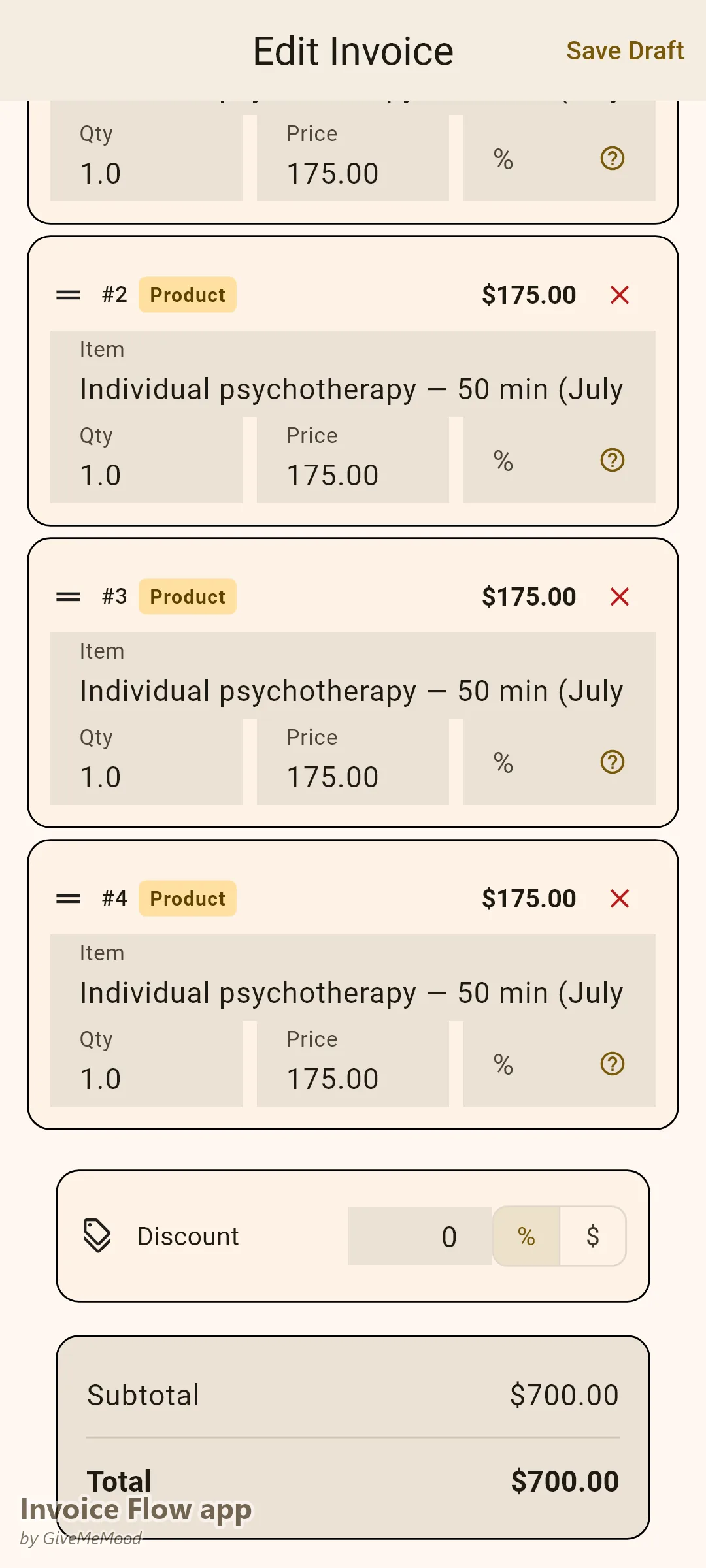
I don’t offer packages in the traditional sense — therapy doesn’t work on a session-count model the way fitness does. But I do offer prepaid intensive programs for specific interventions.
Intensive Program — [Client Name] — [Date]:
- Program: [EMDR intensive / Grief program / Anxiety protocol]
- Structure: [N] sessions over [N] weeks + between-session support
- Program rate: $[amount]
- Payment: [Paid in full / 2-payment plan: $[deposit] at enrollment + $[balance] at program midpoint]
These are structured short-term treatment programs, not open-ended packages. The invoice documents what’s included, the timeline, and the payment structure.
Corporate EAP-Style Contracts
Direct corporate contracts — bypassing managed care EAP networks — pay significantly more per session and give clinicians control over treatment approach and session limits.
Corporate Employee Assistance Services — [Company Name] — [Month Year]:
Billing Period: [Month Year] Services provided:
- Employee sessions: [N] sessions this month × $[rate]/session = $[total]
- Employee utilization report (aggregate, de-identified): included
- HR consultation (if applicable): [N] hours × $[rate] = $[total]
- Invoice total: $[total]
Remit to: Dr. Simone Hartley, LCSW | EIN: [XX-XXXXXXX] PO Number: [PO-####] Payment Terms: Net-30 W-9 on file
Confidentiality note (include on every corporate invoice): “Session content is confidential. This invoice reports session count only. No clinical information is shared with the employer.”
This note is not just ethical practice — it protects your clients and your clinical relationship. HR should know utilization numbers, not clinical content. Including this note preemptively addresses the concern before HR asks.
Sliding Scale and Reduced Fee Documentation
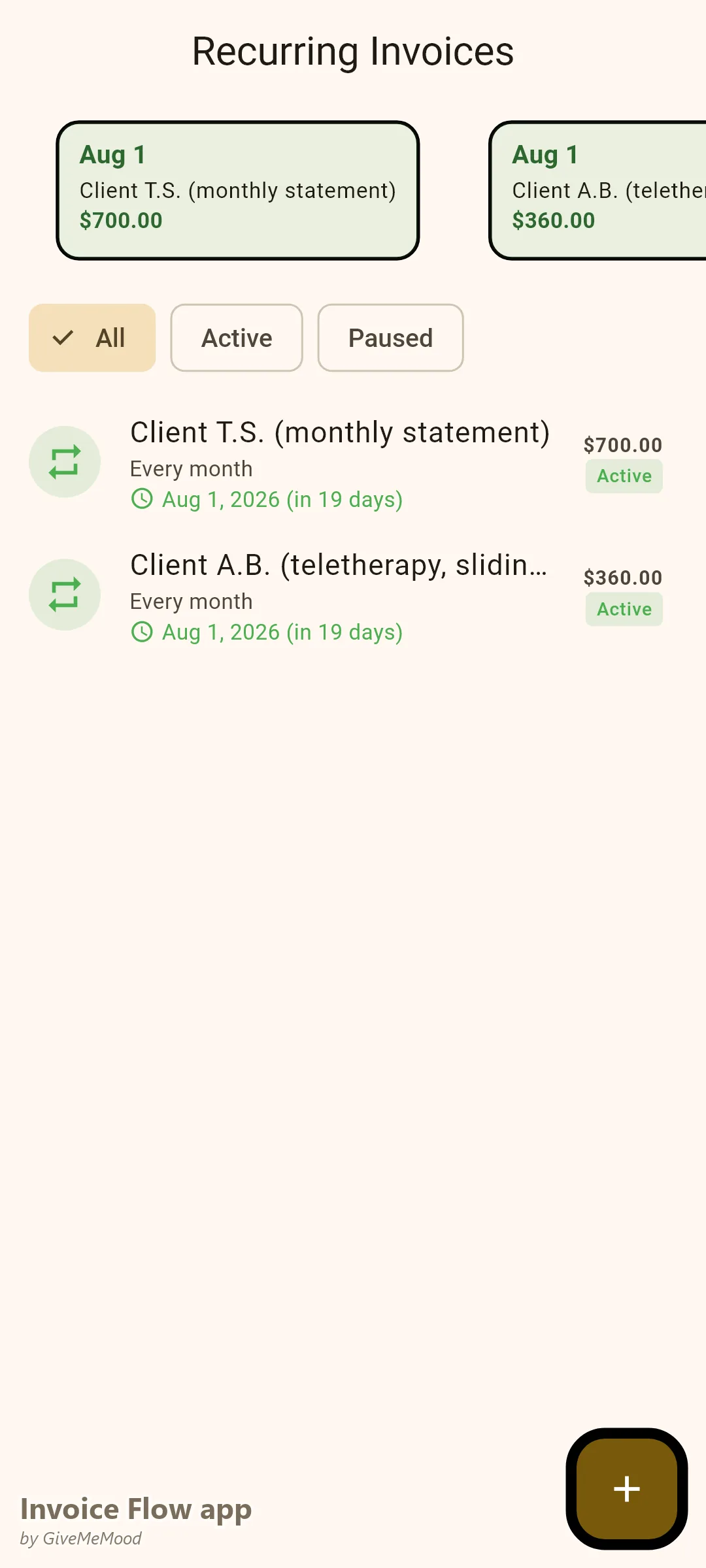
For clients on reduced fees, I document the arrangement clearly:
Reduced Fee Agreement — [Client Name] — [Date]:
- Standard session fee: $[amount]
- Agreed reduced fee: $[amount]/session
- Basis: [Income-based / Temporary hardship / Pro bono (no charge)]
- Duration: [Open-ended / Through [date] / Until reviewed]
- Review date: [Date]
Documenting the reduced fee protects both parties. If a client disputes a charge later, the signed agreement is the record.
Group Therapy Billing
Groups require separate session invoices per participant.
Group Therapy Session — [Client Name] — [Date]:
- Group: [Group name — e.g., Anxiety Support Group / Grief Group]
- Session date: [Date] | Duration: [N] min
- CPT: 90853 (Group psychotherapy)
- Session fee: $[amount]
- Payment: Paid via the method shown on the invoice
Each participant gets their own invoice with their own CPT code and diagnosis. Never put multiple participants on one invoice — each client’s session is a separate billable service.
Workshop and Training Invoices
I periodically offer CEU workshops for other clinicians and corporate mental health training.
Workshop Invoice — [Organization / Individual] — [Date]:
- Workshop: [Title] | Date: [Date] | Hours: [N]
- Format: [In-person / Webinar]
- Participants: [N]
- Registration: $[amount] per participant × [N] = $[total]
- PO Number: [PO-####] (if corporate)
- Payment Terms: [Due at registration / Net-15 (corporate)]
Six Years Private Pay
Current monthly revenue:
- Private-pay individual sessions: approximately $9,200/month
- Corporate EAP-style contracts (2 companies): approximately $7,800/month
- Intensive programs: approximately $3,400/month
- Group therapy (2 groups, 8 participants each): approximately $2,800/month
- Clinical supervision (4 supervisees): approximately $1,600/month
- CEU workshops (irregular): approximately $1,200/month
- Total monthly revenue: approximately $26,000/month
At $87/session through insurance, this revenue would require approximately 300 sessions per month. I’m at approximately 80 clinical hours per month.
Download InvoiceFlow. Build your session + superbill template with CPT and ICD-10 fields. Add EIN and confidentiality note to your corporate template. Generate a superbill at every session — your clients have out-of-network benefits they’re not using.
Dr. Simone Hartley is a licensed clinical social worker in Chicago, Illinois, with a private practice serving individual clients, corporate EAP accounts, group therapy, and clinical supervision.