 EN
EN  العربية
  Български
  Čeština
  Dansk
Dansk  Deutsch
  Ελληνικά
  Español
  Suomi
Suomi  Français
  עברית
עברית  हिन्दी
  Bahasa Indonesia
  Italiano
  日本語
日本語  한국어
한국어  Bahasa Melayu
  Nederlands
  Norsk
Norsk  Polski
  Português
  Română
  Русский
  Svenska
  Kiswahili
  ไทย
ไทย  Türkçe
  Українська
  Tiếng Việt
  中文
中文 The Corporate Account That Turned My Meal Prep Side Hustle into a Business
By Nathan Brooks, Meal Prep Service Owner — Nashville, TN
I started prepping meals for myself in 2019. By mid-2020, four coworkers were paying me $85/week to prep their meals too. I was doing it out of my home kitchen on Sunday afternoons. It was a side hustle, not a business.
The side hustle became a business in one phone call. A health-focused tech company in Nashville called — they’d seen my Instagram — and asked if I could supply their employee wellness program. Sixty employees who wanted weekly lunch meal prep delivered to the office on Mondays.
I said yes. Then I spent the next two weeks trying to figure out how to send them an invoice.
The Corporate Account Problem
The company’s HR manager was polite but firm: they needed a formal invoice with their purchase order number, my business name and EIN on file, and a payment structure their AP department could process. A Venmo request for $3,200 wasn’t going to work.
I had no business entity. I had a Square account and a Venmo handle. I’d been billing my four individual clients by Venmo and tracking their payments in a Google Sheet.
I spent a weekend forming an LLC, opening a business bank account, and downloading InvoiceFlow. I built the corporate meal prep invoice template from scratch based on what the HR manager described.
Corporate Meal Prep — [Company Name] — Week of [Date]:
- Program: Employee Wellness Meal Prep Program
- Week of: [Date]
- Participants this week: 60 employees
- Meal plan: 5 lunches per employee (Monday delivery, Monday–Friday)
- Per-meal rate: $9.50/meal
- Total meals: 60 participants × 5 meals = 300 meals
- Meal total: 300 × $9.50 = $2,850.00
- Packaging and containers: 60 × $1.25 = $75.00
- Delivery fee: $95.00
- Weekly total: $3,020.00
- PO Number: PO-2026-WELLNESS-0012
- Payment Terms: Net-15
- EIN: [###-######]
The EIN requirement surprised me. Corporate AP departments need it for 1099 processing. Once I had the LLC and EIN on the invoice, the company’s payments started clearing within ten business days without any follow-up.
Individual Subscriber Invoices
Before the corporate account, my individual clients were paying by Venmo with no formal invoice. After the corporate account onboarding, I formalized all billing.
Weekly Meal Prep — [Subscriber Name] — Week of [Date]:
- Plan: [Standard / Performance / Premium]
- Meals: [N] meals (lunches + dinners, Monday–Friday)
- Serving size: [1 person / 2 people]
- Per-meal rate: $[rate]/meal
- [N] meals × $[rate] = $[subtotal]
- Packaging: $[amount]
- Weekly total: $[total]
- Payment: Invoice auto-sent on [day before delivery]; pay via the payment link/method shown on it
- Delivery: [Day] between [time window]
The auto-sent recurring invoice was the billing change that scaled the individual subscriber side of the business. When I was Venmo requesting clients manually every week, late payments and forgotten payments were constant. An invoice that goes out automatically before delivery — with my payment link right on it — eliminated both.
Monthly Subscription Invoices
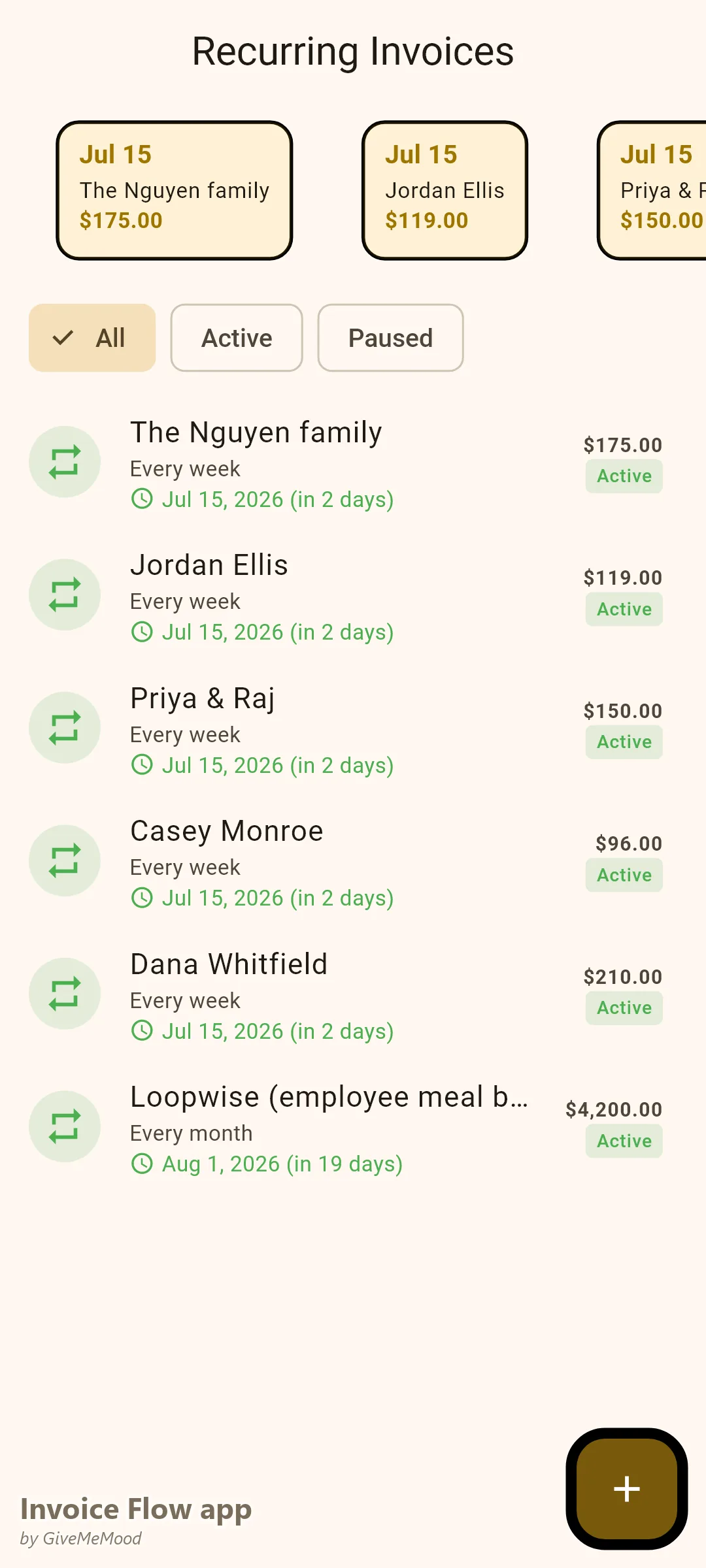
High-volume clients — people who meal prep every week without fail — convert to monthly subscriptions at a slight discount.
Monthly Meal Prep Subscription — [Subscriber Name] — [Month Year]:
- Plan: [Standard / Performance / Premium]
- Monthly subscription: 4 weeks × $[weekly rate]/week = $[undiscounted total]
- Monthly subscription rate: $[discounted total] (saves $[savings]/month)
- Invoice auto-generated and sent on the 1st of the month
- Delivery: [Day] each week | Delivery window: [Time]
- Menu confirmation: Sent by [Day] each week for following week delivery
- Skip or pause: [N] business days notice required
Monthly subscribers currently represent about 65% of my individual client base. One invoice per month, auto-sent. No weekly manual billing.
Dietary-Specific Meal Plans
Specialized plans — keto, plant-based, macro-optimized, allergy-restricted — are priced at a premium because of the sourcing complexity.
Specialty Meal Prep — [Subscriber Name] — Week of [Date]:
- Plan: [Keto / Plant-Based / Macro-Optimized / Allergy-Restricted]
- Specifications: [List — e.g., under 30g net carbs/meal, nut-free, dairy-free]
- Meals: [N] meals this week
- Per-meal rate: $[premium rate]/meal (includes specialty ingredient sourcing and premium packaging)
- [N] meals × $[rate] = $[subtotal]
- Specialty ingredient sourcing fee: $[amount]
- Weekly total: $[total]
- Note: Specialty ingredients sourced from [market/supplier]. Substitutions confirmed by [day] if unavailable.
The specialty ingredient sourcing fee — separate from the per-meal rate — was a lesson I learned from a client who wanted organic, single-source everything for a medically-supervised elimination diet. Her ingredient costs alone were nearly double standard clients. I was losing money on the engagement until I added the specialty sourcing line.
Corporate Wellness Program Monthly Invoice
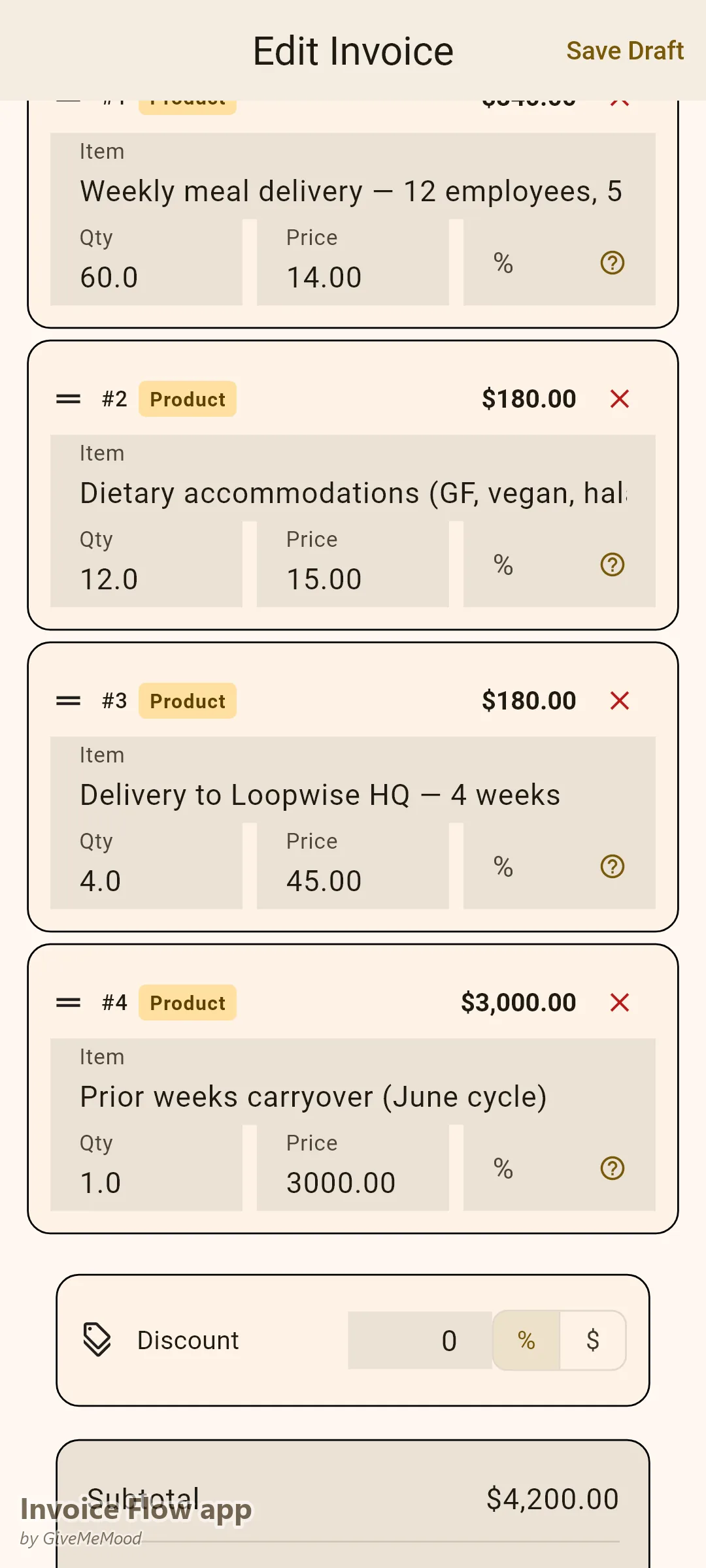
Large corporate clients with stable weekly headcounts get monthly consolidated invoices.
Corporate Wellness Meal Prep — [Company Name] — [Month Year]:
- Program: Employee Wellness Meal Prep — Monthly Billing
- Weeks this month: [List dates of 4 delivery weeks]
- Average weekly headcount: [N] employees (see attached weekly participation log)
- Weekly base: [N] meals × $9.50/meal + $75.00 packaging + $95.00 delivery = $[weekly subtotal]
- 4 weeks × $[weekly subtotal] = $[monthly subtotal]
- Monthly volume discount (5%): -$[discount]
- Monthly total: $[total]
- PO Number: PO-2026-WELLNESS-0012
- Payment Terms: Net-15
- Participation log: [Attached — weekly headcount by department]
The participation log attached to the monthly invoice is the corporate client’s tool for allocating costs across departments. The first company I added it for told me it saved their HR team two hours of reconciliation per month. That detail keeps the account sticky.
Meal Kit Pre-Orders (Occasional Clients)
Some clients don’t want a subscription — they want to order occasionally, typically before a vacation or busy period.
Meal Kit Pre-Order — [Client Name] — [Date]:
- Order: [N] meals | Delivery: [Date], [Time window]
- Menu: [List confirmed meals — or “standard rotation for week of [Date]”]
- Per-meal rate: $[rate] (includes packaging)
- [N] meals × $[rate] = $[subtotal]
- One-time delivery fee: $[amount]
- Total: $[total]
- Payment: Due before preparation begins ([Date])
- Note: Pre-orders finalized [N] business days before delivery. No cancellations after confirmation.
Pre-orders are paid before preparation — not on delivery. This is the same principle as the pre-delivery payment model for weekly subscribers: I don’t buy ingredients I haven’t been paid for.
The Business Four Years In
Current revenue breakdown:
- Corporate wellness accounts (3 companies): $3,020 + $2,240 + $1,680 = $6,940/week = ~$27,760/month
- Individual monthly subscribers (48): average $[X]/month each = $8,160/month
- Individual weekly subscribers (22): average $[X]/week each = $2,860/month (estimated)
- Occasional pre-orders: approximately $1,400/month
- Total monthly revenue: approximately $40,180/month
Side hustle revenue in 2020: approximately $1,840/month from four clients. Current: on pace for approximately $482,000 this year.
The corporate account didn’t just add a client. It forced me to build the business infrastructure I should have had from the start — a proper entity, business banking, and professional invoicing. InvoiceFlow was the billing piece of that.
What InvoiceFlow Does for Meal Prep Services
Meal prep billing spans weekly individual subscriber invoices auto-sent before delivery, monthly subscription billing, corporate wellness program invoices with PO fields and participation logs, specialty plan billing with sourcing fees, and occasional pre-order invoices. InvoiceFlow handles all of these from one Android app — recurring individual and corporate invoices, auto-billing, deposit and pre-payment tracking, and the EIN and PO fields that corporate AP departments require.
Download InvoiceFlow. Build the corporate meal prep template with PO field, EIN, and net-15 terms. Set individual subscribers to weekly recurring auto-invoicing. Convert your regular weekly clients to monthly subscriptions. The corporate account that pays net-15 on a weekly program is the most stable revenue in the meal prep business — and it starts with an invoice that an AP department can actually process.
Nathan Brooks is the owner of Nashville Meal Prep Co. in Nashville, Tennessee, providing weekly individual meal prep subscriptions, corporate wellness meal programs, specialty dietary plans, and occasional meal kit pre-orders.