 EN
EN  العربية
  Български
  Čeština
  Dansk
Dansk  Deutsch
  Ελληνικά
  Español
  Suomi
Suomi  Français
  עברית
עברית  हिन्दी
  Bahasa Indonesia
  Italiano
  日本語
日本語  한국어
한국어  Bahasa Melayu
  Nederlands
  Norsk
Norsk  Polski
  Português
  Română
  Русский
  Svenska
  Kiswahili
  ไทย
ไทย  Türkçe
  Українська
  Tiếng Việt
  中文
中文 The Café Account That Taught Me How to Invoice a Bakery
By Diane Kowalski, Bakery Owner — Portland, OR
I opened Honeycomb Bakery in 2016 out of a commercial kitchen I was renting by the hour. For the first two years, everything was retail — farmers markets, pop-ups, a small pre-order system through Instagram. Then in late 2018 a café four blocks from my house asked if I’d supply their pastry case.
Eight croissants per day. Twelve muffins. Six scones. They wanted delivery Monday, Wednesday, and Friday. They had about twenty thousand dollars a month in foot traffic.
I said yes immediately.
Three months later, I had a spreadsheet problem, two missed payments, and a first-week invoice the café bookkeeper described as “just a photo of your logo with a number.” I’d built a retail business. I had no idea how to bill wholesale.
The Wholesale Account Invoice Problem
The café’s bookkeeper was right. My invoicing was embarrassing. I was texting her a total at the end of the week, and she needed a formal invoice with line items, a PO number, and an invoice number she could track.
I also didn’t understand how net-30 worked in practice. They’d said “net-30” at the start, which I understood to mean they’d pay within thirty days. What I didn’t understand was that the clock started when they received the invoice — and if I didn’t send the invoice until the end of the month, the thirty days started then.
I was invoicing weekly deliveries all at once at the end of the month, then waiting another thirty days. My cash was tied up for sixty days on supplies I’d bought and delivered six weeks earlier.
The café account was $2,800/month. With my broken billing cycle, I was perpetually owed one to two months of revenue. The first time I actually mapped it out, I was sitting on $4,900 in outstanding receivables from one account.
I fixed three things: invoice frequency, invoice format, and net terms.
The Weekly Wholesale Invoice
After the café problem, I moved wholesale accounts to weekly invoicing with net-7 terms. Net-7 is unusual for wholesale — most bakeries invoice monthly with net-30. But for a small business with daily production costs, waiting thirty days was unsustainable.
Wholesale Bakery — Weekly Invoice — [Account Name] — Week of [Date]:
Account Details:
- Account: [Café/Restaurant name]
- Delivery schedule: [Monday, Wednesday, Friday — three deliveries this week]
- Invoice period: [Monday Date] – [Friday Date]
Deliveries This Week:
- Monday [Date]: 8 croissants × $3.50 = $28.00 | 12 muffins × $2.75 = $33.00 | 6 scones × $3.00 = $18.00 | Delivery: $0 (included). Monday subtotal: $79.00
- Wednesday [Date]: 8 croissants × $3.50 = $28.00 | 12 muffins × $2.75 = $33.00 | 6 scones × $3.00 = $18.00. Wednesday subtotal: $79.00
- Friday [Date]: 8 croissants × $3.50 = $28.00 | 14 muffins × $2.75 = $38.50 | 6 scones × $3.00 = $18.00. Friday subtotal: $84.50
- Weekly total: $242.50
- Payment Terms: Net-7 | Due: [Date 7 days after invoice]
- PO Number: [PO-2026-0044]
The itemization by delivery day was my café bookkeeper’s specific request — she needed to reconcile deliveries against her receiving log. Once I started matching her format, invoice disputes dropped to zero.
Custom Cake and Special Order Invoices
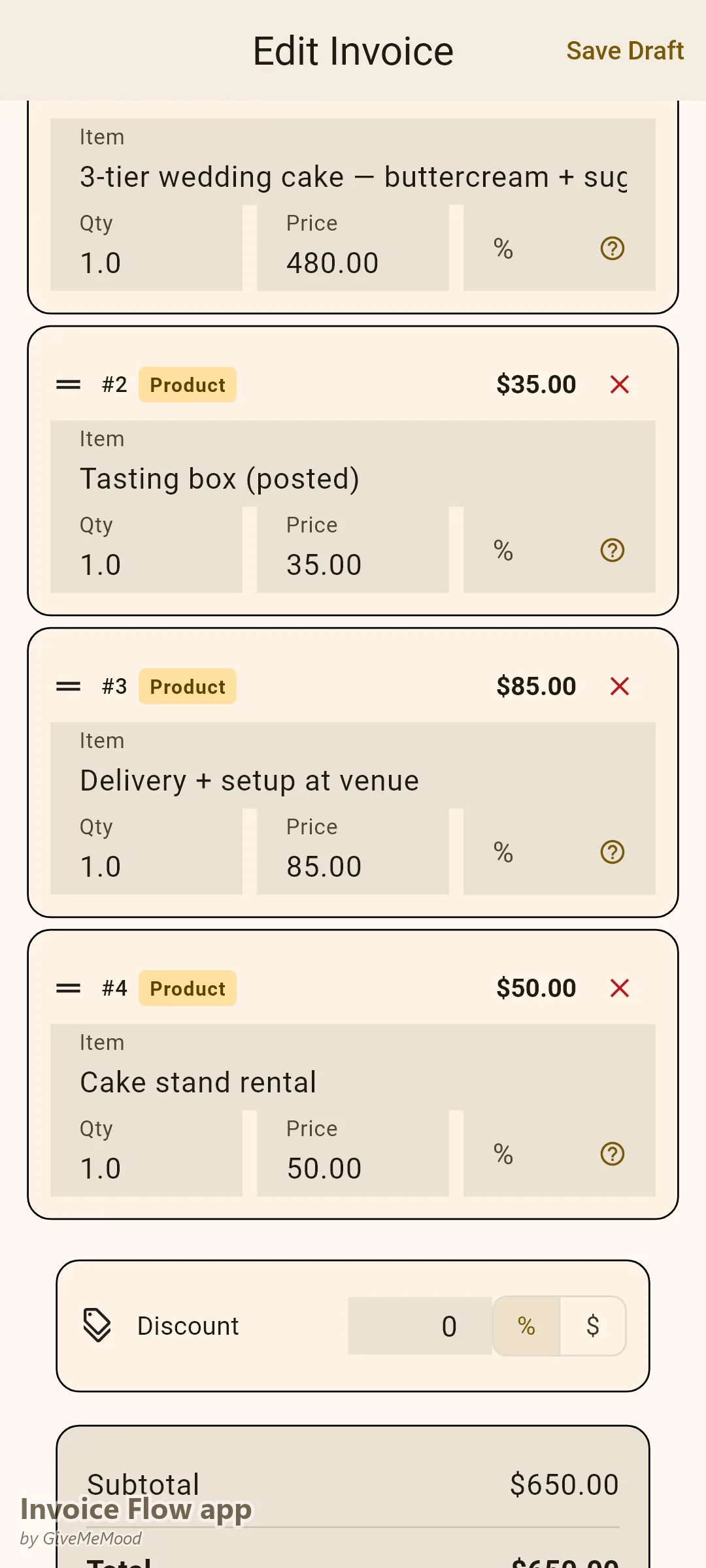
Custom orders — wedding cakes, birthday cakes, specialty baked goods — require a deposit structure. The materials and labor go in before the order is picked up.
Custom Order — [Client Name] — [Pickup/Delivery Date]:
- Order: [Description — e.g., four-tier wedding cake, fondant, floral decoration, vanilla bean and raspberry filling]
- Pickup date: [Date] | Pickup location: [Address] or delivery to [Venue]
- Custom order fee: $[amount]
- Dietary modifications: [Gluten-free / nut-free / vegan — additional charge: $[amount]]
- Order total: $[total]
- Deposit (50%, non-refundable, due at order confirmation): $[deposit]
- Balance (due at pickup or delivery): $[balance]
- Cancellation: Deposit non-refundable. Full fee charged for cancellations within 72 hours of pickup date.
- Tasting session: [Included / scheduled for Date at Address / $[fee] applied toward order]
The deposit for custom orders is essential. I once made a $380 custom birthday cake — fondant decorations, specific color scheme, the client’s child’s name in script — and the client didn’t show up. The deposit I’d collected was $100 at the time. I lost $280 worth of materials and a full Saturday of labor.
Now, custom orders are 50% non-refundable at confirmation. The deposit covers materials. The balance is collected at pickup.
Corporate and Event Pre-Orders
Offices, event coordinators, and venue contacts often place large pre-orders for meetings, office breakfasts, and catered events.
Corporate Pastry Pre-Order — [Company Name] — [Date]:
- Order: [Event description — Monthly team breakfast / board meeting pastries / client presentation setup]
- Delivery date: [Date] | Time: [Time] | Location: [Address]
- Items:
- Assorted croissants (24): 24 × $3.50 = $84.00
- Blueberry muffins (18): 18 × $2.75 = $49.50
- Sourdough loaves (4): 4 × $9.00 = $36.00
- Mixed berry scones (12): 12 × $3.00 = $36.00
- Subtotal: $205.50
- Corporate delivery fee: $25.00
- Total: $230.50
- PO Number: [PO-####]
- Payment Terms: Net-15
- Order Deadline: Orders must be placed [N] business days in advance
Corporate pre-orders are where PO numbers matter. A real estate firm I supply for monthly agent breakfasts had me wait eight weeks for a $460 payment once because I didn’t have a PO number on the invoice. Their accounts payable system couldn’t process it. Now I ask for the PO at order time.
Farmers Market and Retail Sales Receipts
Farmers market sales are cash and card — no invoicing needed. But some customers want a receipt for expense reporting or business tax purposes.
Retail Sales Receipt — Honeycomb Bakery — [Date]:
- Items:
- Sourdough boule (1): $12.00
- Cinnamon rolls, half dozen: $18.00
- Cardamom muffins (2): $7.00
- Total: $37.00
- Payment: Paid [cash/card]
- Note: Receipt for expense/tax purposes
InvoiceFlow generates these quickly when customers ask — a professional receipt with my business name and contact, sent to their email.
Subscription and Standing Order Invoices
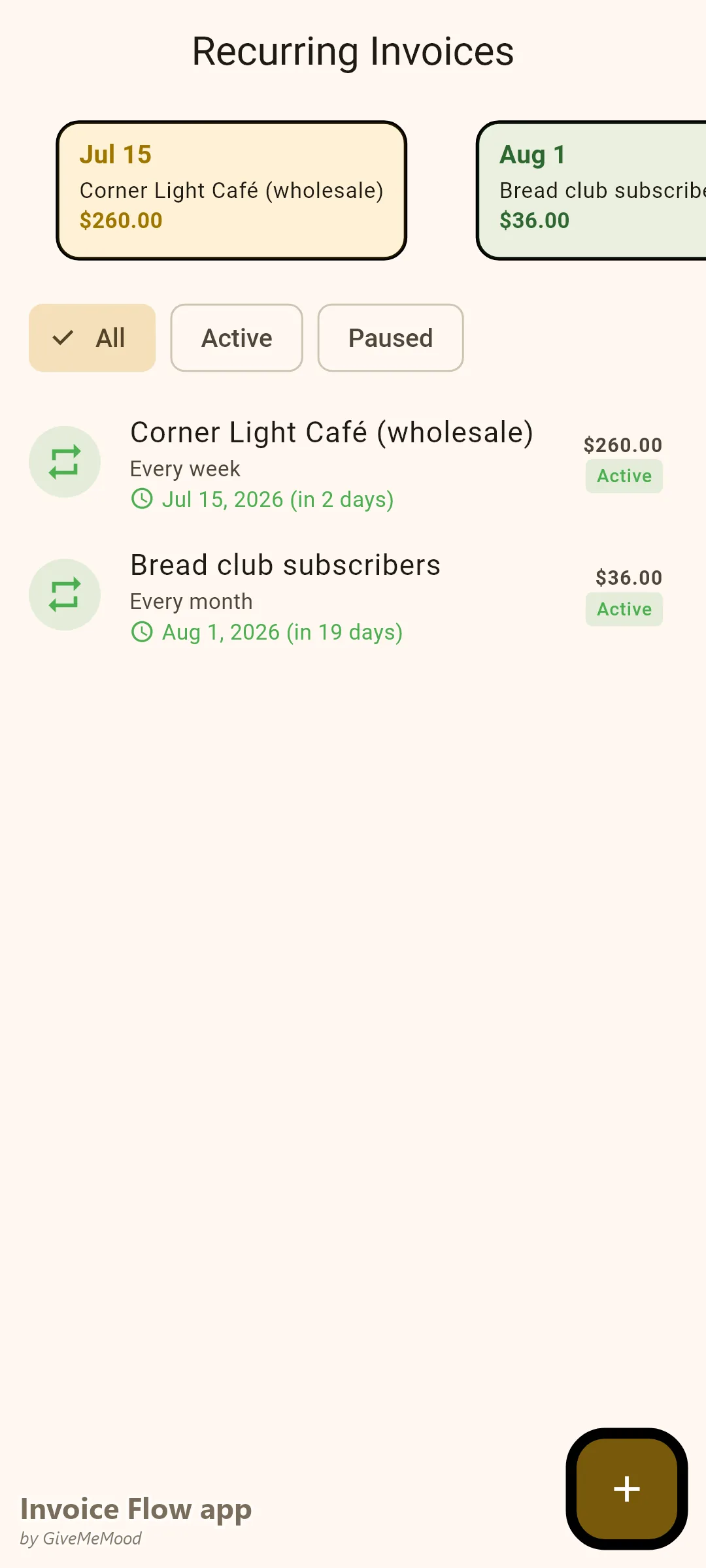
Some clients place the same order every week — a restaurant that orders bread twice a week, a household that subscribes to a weekly pastry box. For these, I use a recurring invoice.
Weekly Pastry Box Subscription — [Client Name] — Week of [Date]:
- Subscription: Honeycomb Weekly Pastry Box — Standard (serves 2–3)
- Contents: 4 assorted pastries + 1 specialty loaf + seasonal jam
- Subscription rate: $48.00/week
- Invoice auto-generated and sent weekly on [day]. Client pays via the payment method shown on the invoice.
The subscription model took me two years to try, and I wish I’d started sooner. Thirty-one active subscriptions at an average of $52/week = $1,612/week in guaranteed revenue, regardless of weather or market day.
The Business Eight Years In
Current revenue breakdown:
- Wholesale accounts (4 accounts): $2,800 + $2,200 + $1,600 + $940 = $7,540/month
- Subscription boxes (31 active): 31 × $52 average = $6,552/month
- Custom cakes and specialty orders (12–16/month): approximately $4,200/month
- Farmers market and retail (2 markets/week): approximately $3,100/month
- Corporate pre-orders: approximately $1,400/month
- Total monthly revenue: approximately $22,800/month
When I was selling at farmers markets only, I was making about $2,800/month. Wholesale accounts changed the floor. Subscriptions changed the ceiling.
What InvoiceFlow Does for Bakeries
Bakery billing spans wholesale weekly invoices with delivery-day itemization, custom cake deposits with cancellation policies, corporate pre-orders with PO fields, retail receipts, and recurring subscription billing. InvoiceFlow handles all of these from one Android app — weekly recurring invoices for wholesale accounts, deposit tracking for custom orders, and PO fields for corporate clients.
Download InvoiceFlow. Build the wholesale invoice template with delivery-day itemization and net-7 terms. Set up subscription billing with weekly auto-invoicing. Add the deposit and cancellation policy to custom order invoices. The café account that pays net-7 is worth more than a month of market tables — and it starts with a professional invoice.
Diane Kowalski is the owner of Honeycomb Bakery in Portland, Oregon, providing wholesale pastries, custom cakes, subscription boxes, retail market sales, and corporate pre-orders.