
 EN
EN  العربية
  Български
  Čeština
  Dansk
Dansk  Deutsch
  Ελληνικά
  Español
  Suomi
Suomi  Français
  עברית
עברית  हिन्दी
  Bahasa Indonesia
  Italiano
  日本語
日本語  한국어
한국어  Bahasa Melayu
  Nederlands
  Norsk
Norsk  Polski
  Português
  Română
  Русский
  Svenska
  Kiswahili
  ไทย
ไทย  Türkçe
  Українська
  Tiếng Việt
  中文
中文 The Billing System That Helped Me Leave Big Law and Keep My Clients
By Diane Mercer, Attorney — Solo Practice — Boston, MA
I left a 140-attorney firm after eleven years. The reasons were standard: billable hour pressure, management drift, a practice area I’d outgrown. What I hadn’t anticipated was that the infrastructure I’d taken for granted — billing software, paralegal support, accounts receivable — would disappear with the paycheck.
My first three months as a solo practitioner were professionally fine and administratively embarrassing. I was doing excellent legal work. I was also tracking billable hours in a spreadsheet, writing invoices in a Word document, and sending them by email with apologies for the formatting.
Two clients made comments. One — a small business owner I’d represented for years — said he’d always assumed my old firm had a sophisticated billing system and wondered whether I had the same infrastructure now. Another client, a family running an estate matter, asked why the invoice looked different every month.
They were being polite. The invoices were inconsistent and unprofessional.
The Specific Problems with Manual Legal Billing
Legal billing is more complex than most professional service billing. The issues I was managing manually:
Multiple matters per client. The same client might have an employment matter, a contract review, and a lease negotiation running simultaneously. Each matter needs its own billing line. Consolidated invoicing across matters causes confusion and, occasionally, disputes about which work applies to which retainer.
Retainer tracking. Many of my clients pay an advance retainer. I bill against it monthly and replenish requests when balances fall below a threshold. Tracking retainer balances manually — across seven clients simultaneously — was a constant source of anxiety. I made two billing errors in three months that required client correction emails.
IOLTA compliance. Retainer funds must be held in a client trust account and not touched until earned. The accounting discipline required is different from general business billing. Getting this wrong creates bar complaint exposure.
Time tracking across engagements. I move between client matters throughout the day. Reconstructing billable time from memory at the end of the week is unreliable. I was underbilling by an estimated 15-20% simply because I wasn’t capturing time at the point of work.
I found InvoiceFlow after searching for apps that could handle per-matter invoicing with retainer tracking. It didn’t solve the IOLTA accounting (for that I use dedicated trust accounting software), but it solved everything else.
The Monthly Retainer Invoice
For clients on monthly retainers, I send a two-part invoice: the retainer replenishment request and the detailed billing statement.
Matter-Based Invoice — [Client Name] — [Month Year]:
- Matter: [Company Name] Employment Litigation — Case No. [Number]
- Retainer balance at start of period: $4,200.00
- Hours billed this period: 6.4 hours × $385/hour: $2,464.00
- Disbursements (court filing fee): $350.00
- Total billed this period: $2,814.00
- Retainer balance after billing: $1,386.00
- Replenishment requested to restore to $4,000.00 minimum: $2,614.00
- Please remit: $2,614.00 to restore retainer balance
The replenishment amount and current balance are explicit on every invoice. The client can see exactly where their retainer stands without a phone call.
Hourly Billing Invoices Without a Retainer
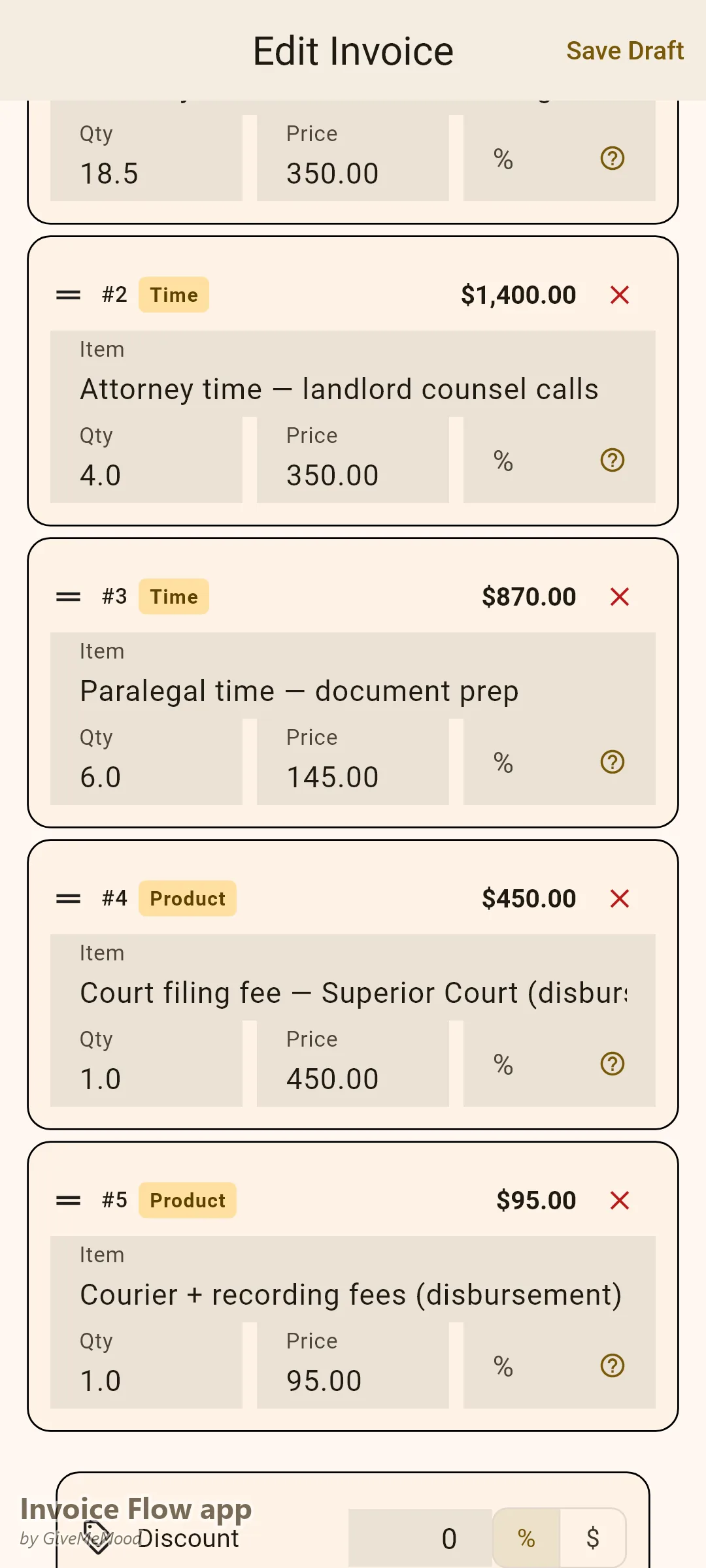
For transaction-based matters where the client pays per invoice rather than maintaining a retainer:
Matter Invoice — [Client Name] — [Month Year]:
- Matter: Residential Real Estate Purchase — [Address]
- Services: Title review, purchase agreement negotiation, closing coordination
- 4.5 hours × $385/hour: $1,732.50
- Disbursements: Title search fee $125.00, recording fees $85.00
- Total due: $1,942.50
- Payment Terms: Net-15
Disbursements are documented separately from legal fees. Clients sometimes question a lump sum — they never question itemized costs they recognize.
Flat-Fee Matter Invoices
Some matters are better billed flat-fee. Will and trust packages, simple contract reviews, standard formation documents:
Flat-Fee Legal Services — [Client Name] — [Date]:
- Service: Estate Planning Package — Will, Healthcare Directive, Durable Power of Attorney
- Scope: Preparation, review session, execution coordination
- Flat fee: $2,400.00
- Deposit (50%, due at engagement start): $1,200.00
- Balance (due upon document execution): $1,200.00
Flat-fee billing is cleaner for clients who are uncomfortable with open-ended hourly arrangements. The scope definition on the invoice — “preparation, review session, execution coordination” — sets expectations and limits scope creep.
Corporate Client Invoices with PO Requirements

Small and mid-size business clients with procurement departments require corporate invoice fields:
Legal Services — [Company Name] — [Month Year]:
- Matter: Commercial Lease Negotiation — [Property Address]
- Matter Number: MAT-2026-0042
- Services: Lease review, negotiation correspondence, rider drafting
- 7.2 hours × $385/hour: $2,772.00
- PO Number: PO-2026-LEGAL-0018
- Billing Contact: [Name], Finance Department
- Payment Terms: Net-30
Corporate clients with procurement workflows process invoices faster when they can match them to PO numbers. Net-30 gets met. Ad-hoc invoicing without a PO reference takes 45-60 days.
Contingency Engagement Invoices
For contingency matters where the fee is a percentage of recovery, the closing invoice at settlement needs careful documentation:
Contingency Fee Statement — [Client Name] — [Date]:
- Matter: [Defendant] Personal Injury Claim
- Settlement amount: $85,000.00
- Contingency fee (33⅓% of settlement): $28,333.33
- Advanced costs (itemized — see attached): $4,218.75
- Net to client: $52,447.92
- Disbursement: Settlement check received [Date]. Client disbursement within 3 business days.
The itemized cost attachment is critical. Clients who receive a contingency closing statement without understanding what’s been deducted will ask questions that delay disbursement. Documenting everything on the closing invoice, with costs attached, prevents almost all disbursement disputes.
Two Years as a Solo Practitioner
Current practice metrics:
- 7 active retainer clients: average retainer $3,800. Monthly retainer billing: approximately $14,200/month
- Transaction matter clients (non-retainer): approximately $6,400/month in net-30 billing
- Flat-fee estate and formation work: approximately $4,800/month
- Total monthly billing: approximately $25,400/month
I am billing more per month than I was earning as a salaried associate. The difference is margin — I keep substantially more of what I bill.
The administrative improvement has been significant. I have not made a retainer balance error in eighteen months. I have not missed a billing cycle. I send invoices on time, they look professional, and clients process them without questions.
The two clients who made comments about my early invoices are still clients. They’ve never mentioned the invoicing again.
What InvoiceFlow Does for Attorneys
Solo and small-firm attorneys need billing systems that handle per-matter invoicing, retainer balance tracking, disbursement line items, flat-fee arrangements, corporate PO fields, and contingency closing statements. InvoiceFlow provides the per-matter invoice structure, retainer replenishment requests, disbursement documentation, and corporate client PO fields that make legal billing professional and consistent.
Download InvoiceFlow. Build matter-level invoice templates. Set up retainer tracking. Stop sending Word document invoices and start billing like the firm you’ve built.
Diane Mercer is an attorney in solo practice in Boston, Massachusetts, providing business law, commercial real estate, employment matters, and estate planning services to small and mid-size businesses and individuals.