 EN
EN  العربية
  Български
  Čeština
  Dansk
Dansk  Deutsch
  Ελληνικά
  Español
  Suomi
Suomi  Français
  עברית
עברית  हिन्दी
  Bahasa Indonesia
  Italiano
  日本語
日本語  한국어
한국어  Bahasa Melayu
  Nederlands
  Norsk
Norsk  Polski
  Português
  Română
  Русский
  Svenska
  Kiswahili
  ไทย
ไทย  Türkçe
  Українська
  Tiếng Việt
  中文
中文 The Invoice That Turned a Private Dinner into a Weekly Client
By Elena Vasquez, Personal Chef — Miami, FL
I left restaurant work in 2017. After eleven years in professional kitchens — starting as a prep cook, ending as sous chef at a 140-seat restaurant in Coral Gables — I wanted to cook for people who actually tasted what I made instead of sending food back because the table needed to turn.
I started doing private dinner parties. A friend of a friend needed a chef for a fortieth birthday dinner for twelve. I cooked, they loved it, I charged $850 and felt like I’d done well.
A year later, I was doing six to eight private dinners per month and making about the same as I had in the restaurant — but working half the hours. The ceiling I’d hit wasn’t talent or demand. It was billing.
The Problem with One-Time Dinner Billing
Every private dinner was a new negotiation. Quote the menu, agree on a price, show up, cook, collect. Some clients paid by Venmo. Some wrote checks I didn’t cash for three weeks because I forgot. Two clients never paid at all — one ghosted after a $600 dinner, one disputed that the price included cleanup (it did; I never invoiced it clearly).
The unpaid $600 was the incident that made me change everything.
I’d texted her a price (“$600 including cleanup and groceries, I’ll Venmo request you after”). She’d said yes. Then she went dark. I had no signed agreement, no deposit, no invoice with terms — just a text exchange and a Venmo request she never accepted.
I wrote off the $600. Then I called a personal chef colleague in Fort Lauderdale who had been doing this for twelve years. She told me one thing: “Every client, every engagement, starts with a signed invoice and a deposit.”
I downloaded InvoiceFlow that week.
Building the Private Chef Billing System
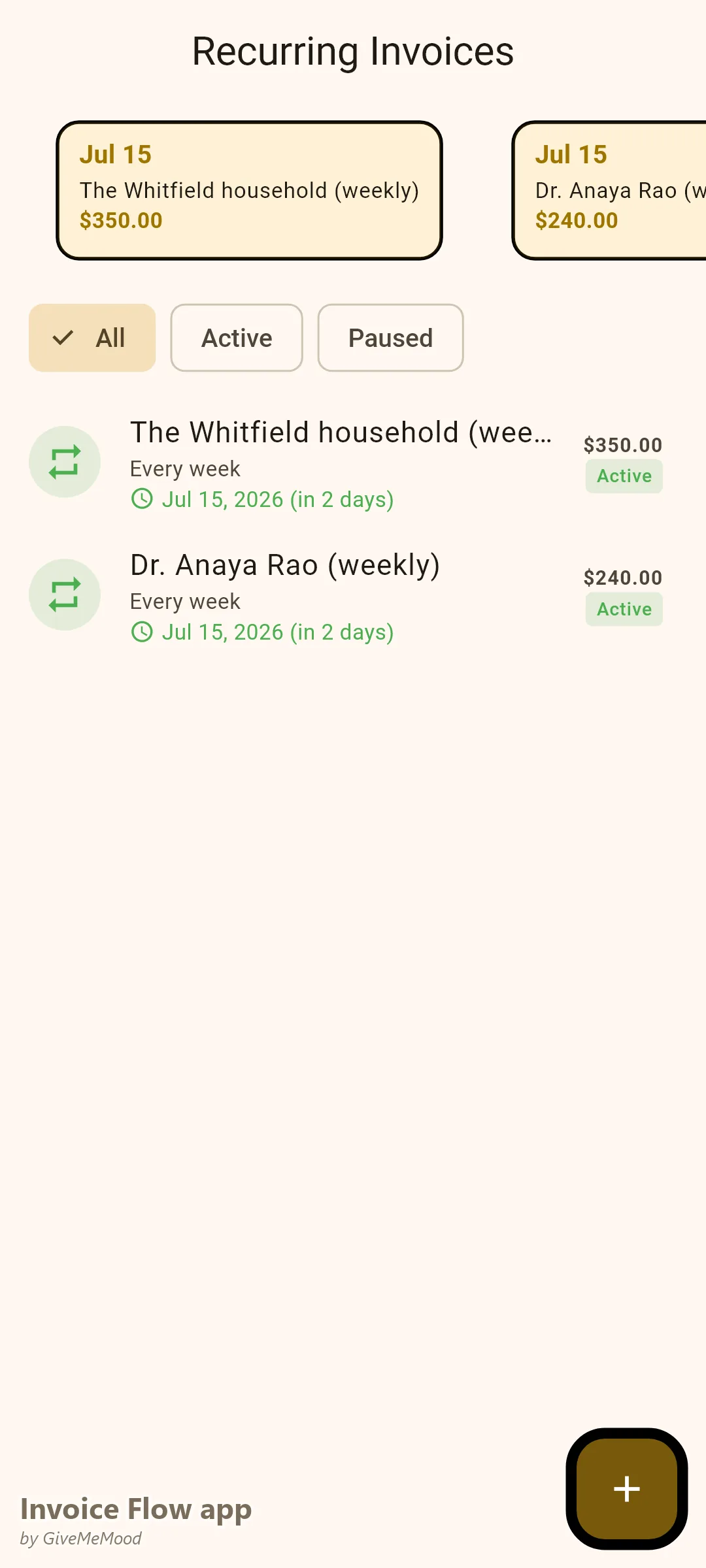
The first thing I built was the weekly meal prep invoice — my bread-and-butter service. A client pays for five dinners per week, four people, meals delivered Sunday afternoon.
Weekly Meal Prep — Private Client — [Client Name] — [Week of Date]:
- Service: Weekly meal preparation — family meals for four
- Schedule: Sunday delivery by 3:00 PM
- Meals this week: 5 dinners (Monday–Friday)
- Menu: [Confirmed menu items — e.g., herb-roasted chicken, pasta primavera, salmon en papillote, beef stew, vegetable curry]
- Per-meal rate: $95/meal (includes grocery sourcing, preparation, packaging, delivery)
- 5 meals × $95 = $475.00
- Grocery sourcing fee (premium/specialty items): $45.00
- Weekly total: $520.00
- Payment Terms: Due before Sunday delivery
- Billing: Auto-generated and sent weekly; pay via the payment link/method shown on the invoice
The auto-sent recurring invoice was the transformation. I stopped chasing payment after delivery. The invoice generates and goes out on Thursday with my payment link on it, the client pays Friday, I shop Saturday, I deliver Sunday. The money arrives before the groceries do.
Monthly Retainer for Regular Clients
Clients who book weekly consistently get the option of a monthly retainer. Simpler for them (one charge per month), more predictable for me.
Monthly Meal Prep Retainer — [Client Name] — [Month Year]:
- Service: Weekly family meal preparation — 4 weeks
- Schedule: Sunday delivery | Meals: 5 dinners/week per week
- Monthly service: 4 weeks × $520/week = $2,080.00
- Monthly retainer rate: $1,950.00 (saves $130 vs. weekly billing)
- Payment Terms: Due on the 1st of the month
- Invoice auto-generated and sent on the 1st. Service period: [Month] 1–[Month] 31.
The monthly retainer saves the client $130 and locks in my schedule for the entire month. I have six retainer clients right now at various service levels — that’s $11,700 in guaranteed monthly income before I book a single private dinner.
Private Dinner Party Invoices
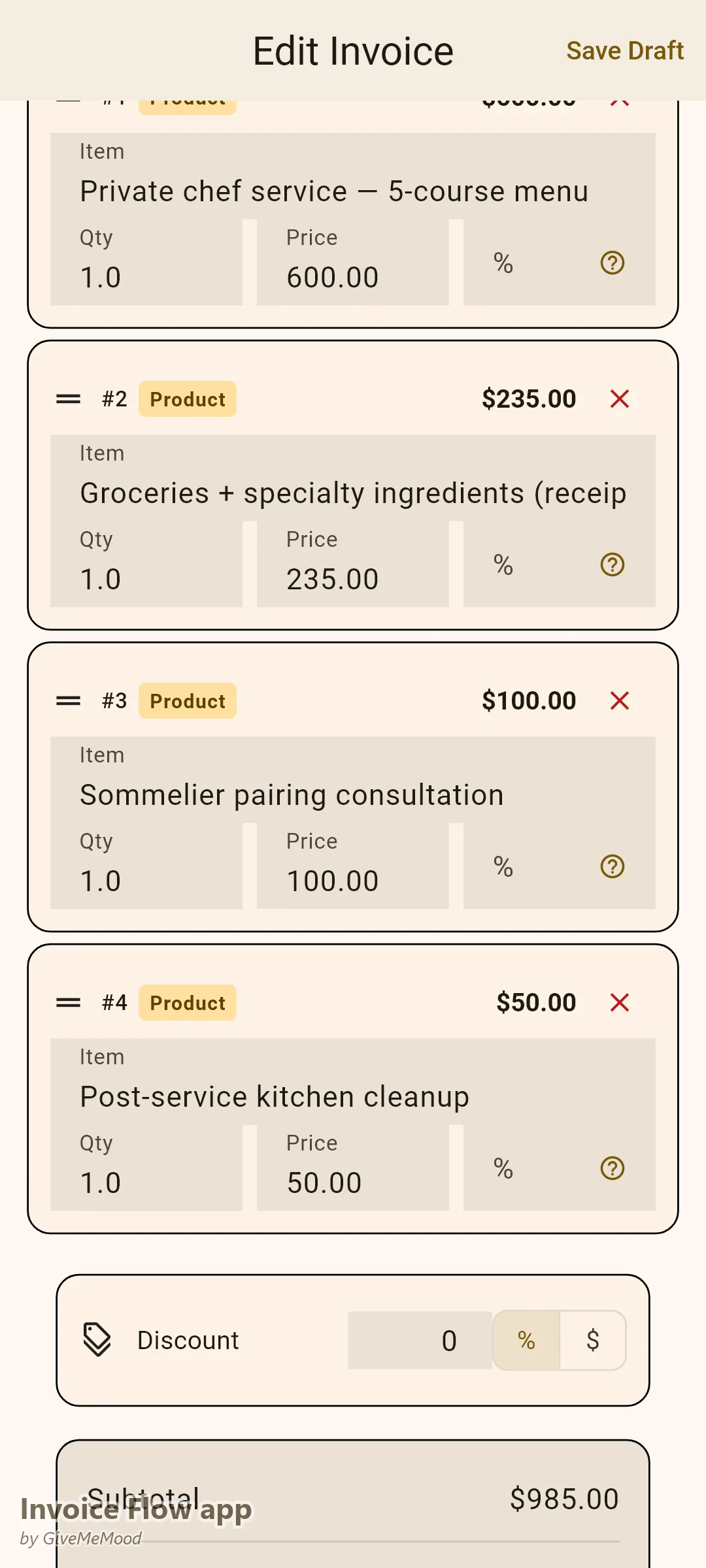
Private dinner parties — the service I started with — now have a proper invoice structure:
Private Dinner — [Client Name] — [Date]:
- Event: [Occasion — birthday dinner / anniversary / dinner party / holiday gathering]
- Date: [Date] | Location: [Address]
- Guest count: [N] guests
- Menu: [Description — e.g., four-course tasting menu: amuse-bouche, seafood crudo, braised short rib, chocolate soufflé]
- Service type: [Plated / family-style / cocktail]
- Chef fee: $[rate] (menu planning, preparation, service, cleanup)
- Grocery sourcing (itemized list provided): $[actual cost + 12% sourcing fee]
- Event total: $[total]
- Deposit (50%, non-refundable, due at booking): $[deposit]
- Balance (due 3 days before event): $[balance]
- Cancellation: Deposit non-refundable. Full fee charged for cancellations within 48 hours.
The grocery sourcing line changed how I think about grocery costs. Before, I was absorbing cost overruns when specialty ingredients were more expensive than expected. Now, groceries are a pass-through at actual cost plus 12% sourcing fee for my time shopping. No surprises for either of us.
Corporate Lunch and Team Event Invoices
Some of my best-paying engagements are corporate: a law firm that does monthly client appreciation lunches, a startup that brings me in for team cooking events, a real estate office that books quarterly dinners for their agents.
Corporate Catering — [Company Name] — [Date]:
- Event: [Description — Monthly client lunch / team cooking event / quarterly appreciation dinner]
- Location: [Office address or venue]
- Guest count: [N] guests
- Menu: [Description]
- Chef fee: $[amount]
- Grocery sourcing: $[amount]
- Total: $[total]
- PO Number: [PO-####]
- Payment Terms: Net-15
Corporate clients always need a PO number and a formal invoice. The law firm’s bookkeeper told me that without a proper invoice with their PO reference, the payment would sit in a queue indefinitely. Once I had InvoiceFlow generating invoices with the PO field, their payments cleared within ten days every time.
Private Cooking Class Invoices
I started offering cooking classes in 2021 — private lessons at the client’s home or small groups at my commissary kitchen.
Private Cooking Class — [Client Name] — [Date]:
- Class: [Description — e.g., Italian pasta from scratch / knife skills / French sauces]
- Date: [Date] | Location: [Address]
- Duration: 2 hours
- Participants: [N] guests
- Class fee: $[amount] (instruction, recipe packet, ingredient cost included)
- Total: $[amount]
- Payment Terms: Due at time of booking (non-refundable)
- Cancellation: Non-refundable. One reschedule permitted with 48+ hours notice.
Classes are paid in full at booking — no deposit structure needed when the total is under $500 and the engagement is a single session.
The Business Five Years In
Current revenue breakdown:
- Monthly retainer clients (6 clients): $1,950 + $1,800 + $1,620 + $1,560 + $1,400 + $1,370 = $9,700/month guaranteed
- Weekly meal prep (non-retainer, rotating clients): approximately $2,600/month
- Private dinner parties (4–6/month): approximately $3,800/month
- Corporate catering and team events: approximately $2,400/month
- Cooking classes: approximately $1,200/month
- Total monthly revenue: approximately $19,700/month
When I left the restaurant in 2017, I was making $52,000 a year as sous chef. This year I’ll earn approximately $236,000.
The food is the same. The clients are different. The billing is what made it a business.
What InvoiceFlow Does for Personal Chefs
Personal chef billing spans weekly meal prep with pre-delivery payment, monthly retainers with auto-billing, private dinner deposits with cancellation policies, corporate catering with PO fields, and cooking class single-session payments. InvoiceFlow handles all of these from one Android app — recurring weekly and monthly invoices, deposit tracking, grocery sourcing as a line item, and PO reference fields for corporate clients.
Download InvoiceFlow. Build your weekly meal prep template with pre-delivery payment. Set up the monthly retainer with auto-billing on the first. Add the deposit and cancellation policy to your private dinner invoice. The client who pays weekly becomes the retainer client who pays monthly — and InvoiceFlow makes it effortless to bill them correctly.
Elena Vasquez is a personal chef in Miami, Florida, providing weekly meal prep, monthly meal retainers, private dinner parties, corporate catering, and cooking classes.