 EN
EN  العربية
  Български
  Čeština
  Dansk
Dansk  Deutsch
  Ελληνικά
  Español
  Suomi
Suomi  Français
  עברית
עברית  हिन्दी
  Bahasa Indonesia
  Italiano
  日本語
日本語  한국어
한국어  Bahasa Melayu
  Nederlands
  Norsk
Norsk  Polski
  Português
  Română
  Русский
  Svenska
  Kiswahili
  ไทย
ไทย  Türkçe
  Українська
  Tiếng Việt
  中文
中文 The $3,200 Move That Almost Ended My Moving Company
By Carlos Mendez, Moving Company Owner — San Antonio, TX
I started my moving company in 2019 with one truck, two employees, and more ambition than business sense. The first year I built enough volume to buy a second truck. The second year I nearly bankrupted the company on a single job.
The move that almost ended me was a residential relocation for a family going from a large house in the suburbs to a downtown apartment. It was our biggest job at the time — estimated at $1,800 for a full day with four crew members. What I did not do: collect a deposit, document the pre-move condition of any items, or have a signed agreement before we started loading.
Three days after delivery, the client called claiming we had damaged a dining table and a custom bookcase. They demanded $1,400 in compensation. I had no photos. My crew had no documentation. The client had no photos of damage either, but without documentation proving the items were undamaged when we loaded them, I had nothing to stand on. I ended up settling for $700 in compensation and discounting the invoice to $1,100.
My actual revenue on a day that should have been $1,800 was $400.
The Three Failures of That Move
When I analyzed what went wrong, it broke into three categories.
No deposit. The family could have cancelled the morning of the move with no financial consequence to them and significant financial damage to me — a blocked truck and crew with no work. I was operating without any protection against late cancellation or no-shows.
No pre-move condition documentation. Without photographs and a signed condition acknowledgment before loading, every damage claim is my word against the client’s. Even with an innocent crew and careful handling, I had no defense.
No signed agreement. The scope, rate, and terms of the move existed only in a quote I had texted to the client. There was no signed document establishing what was agreed before we showed up.
Rebuilding the Business Billing Foundation
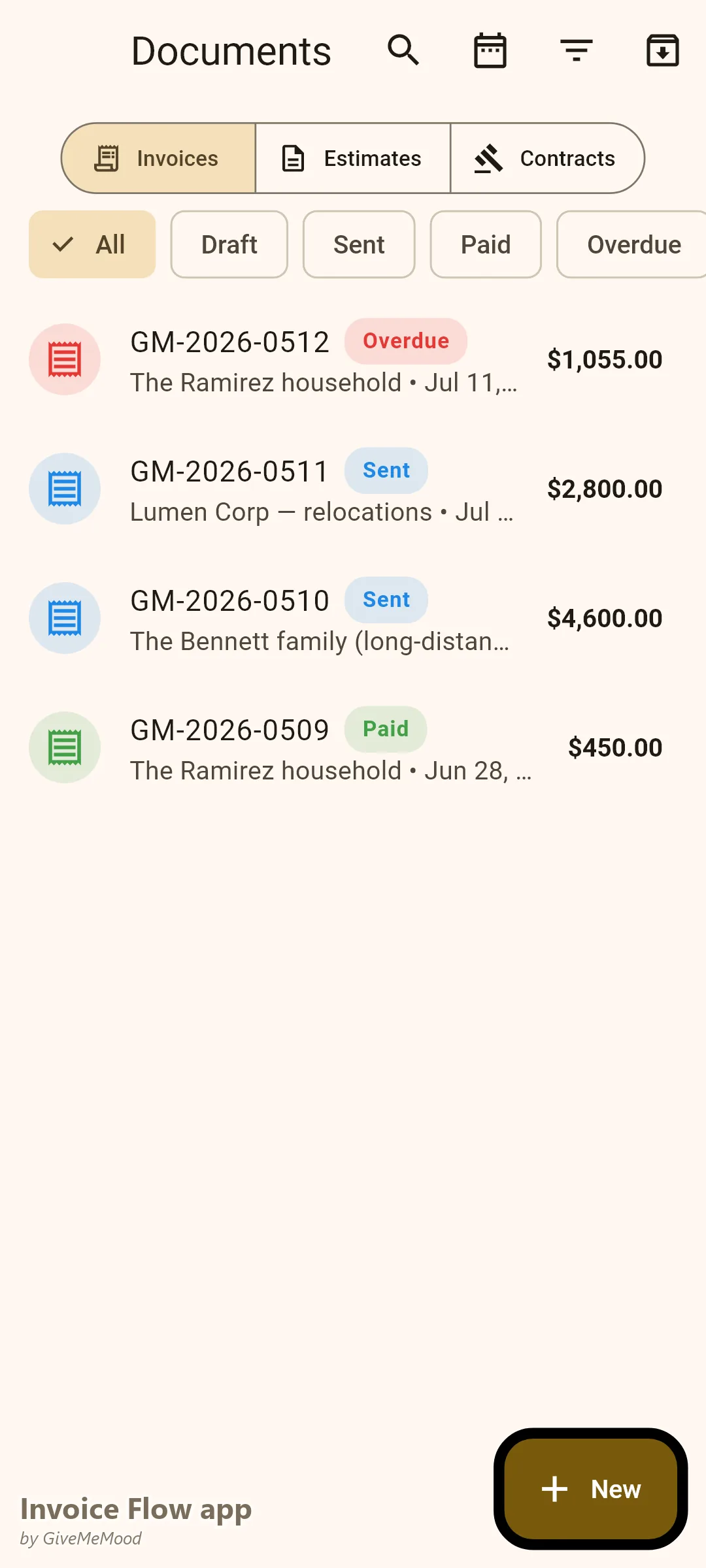
After the settlement, I spent a weekend rebuilding how the company operated. The result was a billing and documentation system that I now apply to every job.
Step 1: The deposit invoice.
Every booked move now requires a deposit invoice before the date is held. My deposits are 25% of the estimated move cost.
“Moving Service Deposit — [Client Name] — Move Date: July 15, 2026: Estimated Move Value: $1,800.00 Deposit (25% — non-refundable within 48 hours of move): $450.00 Remaining balance due upon completion: $1,350.00 Move date confirmed upon receipt of deposit.”
I create this in InvoiceFlow and send it the same day as the booking call. If they do not pay the deposit within 48 hours, the date is not held. Clients who pay a deposit almost never cancel.
Step 2: Pre-move condition photos and acknowledgment.
Before we load the first item, I photograph every piece of furniture and any existing damage to items or the property. I note this in the invoice notes or a separate checklist.
Step 3: The completion invoice with a signed acknowledgment.
When the move is complete, I create the final invoice in InvoiceFlow on-site:
“Moving Services — [Client Name] — July 15, 2026:
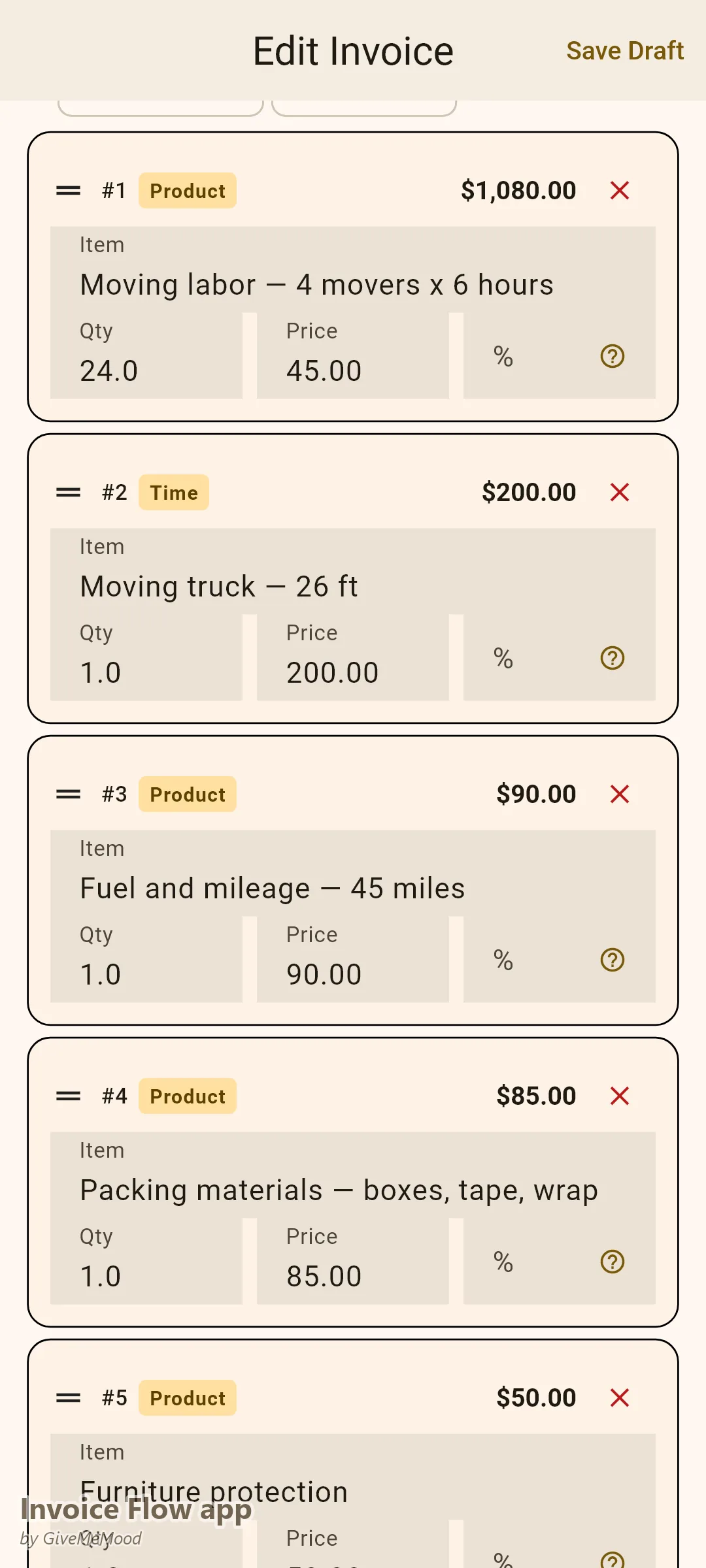
Moving labor — 4 crew members × 8.5 hours: $1,700.00 Truck fee (26’ truck, one way): included Fuel and mileage surcharge: $95.00 Wardrobe box rental (3 boxes, returned): $30.00 Mattress bag (2 queen size): $20.00 Assembly/disassembly — dining table, 2 bed frames: $80.00
Subtotal: $1,925.00 Deposit applied: ($450.00) Balance due: $1,475.00
Client signature confirming satisfactory completion: ___________”
The signature on the completion invoice is the acknowledgment that the move was completed to the client’s satisfaction. It does not eliminate every possible dispute, but it changes the dynamic significantly.
Since implementing this process, I have not had a single post-completion damage dispute that could not be resolved in one conversation.
Long-Distance and Multi-Day Move Billing
As the company grew, we started taking long-distance moves — Texas to another state, or cross-Texas relocations that required overnight stays. These have a more complex billing structure.
“Long-Distance Moving Services — [Client Name]:
Phase 1 — Loading Day (San Antonio): 4 crew × 8 hours: $1,600.00 Truck preparation and wrapping: $150.00 Phase 1 deposit (40%): Due at loading. $700.00
Phase 2 — Transportation (San Antonio → Dallas, 276 miles): Fuel and mileage (276 miles × $1.85): $510.60 Tolls and fees (actual, receipts provided): $42.00 Phase 2 payment: Due at delivery. $552.60
Phase 3 — Unloading and Setup (Dallas): 3 crew × 6 hours: $1,080.00 Assembly — 3 bedrooms, kitchen, living room: $240.00 Phase 3 final payment: Due upon completion. $1,320.00
Total: $4,372.60”
Phase billing on long-distance moves ensures I am not fronting fuel and crew costs across a two-day operation without meaningful payment. Each phase invoice is tied to a specific deliverable moment.
Corporate and Business Relocation Billing
We have done eight commercial relocations in the past two years — offices, small businesses, retail locations. Corporate clients have specific requirements.
“Commercial Moving Services — [Business Name] — Office Relocation: PO Number: PO-2026-FAC-0291 Relocation address: [Old Address] → [New Address] Moving labor — 6 crew × 12 hours: $2,880.00 3 trucks — 16’, 26’, 26’: $450.00 IT equipment handling (specialized): $350.00 After-hours surcharge (moved during non-business hours): $400.00 Furniture installation and setup: $480.00 Total: $4,560.00 Payment Terms: Net-30”
Corporate relocation clients pay promptly on net-30 when the invoice is properly formatted with PO references. I have never had a corporate relocation invoice unpaid beyond terms.
The Numbers After Three Years of Proper Billing
Before the restructuring: unpredictable revenue, no protection against damage disputes, inconsistent cash flow.
After three years of deposit-based invoicing, condition documentation, and completion acknowledgment:
- No unresolved damage disputes in thirty-six months
- Deposit system protected the company from twelve late cancellations — deposit collected in each case
- Commercial relocation accounts representing 30% of annual revenue, all paid within net-30 terms
- Two trucks operating at near-full capacity during peak season
The $700 I paid out on that dining table was the best business education I ever received.
Download InvoiceFlow. Create your deposit invoice. Photograph every item before loading. Sign the completion acknowledgment before you drive away.
Carlos Mendez is the owner of Mendez Moving Company in San Antonio, Texas, providing residential and commercial moving services across the San Antonio metro area and long-distance Texas relocations.