
 EN
EN  العربية
  Български
  Čeština
  Dansk
Dansk  Deutsch
  Ελληνικά
  Español
  Suomi
Suomi  Français
  עברית
עברית  हिन्दी
  Bahasa Indonesia
  Italiano
  日本語
日本語  한국어
한국어  Bahasa Melayu
  Nederlands
  Norsk
Norsk  Polski
  Português
  Română
  Русский
  Svenska
  Kiswahili
  ไทย
ไทย  Türkçe
  Українська
  Tiếng Việt
  中文
中文 InvoiceFlow for Software Development Agencies: Complete Billing Guide
The invoicing system built for custom software shops, dev agencies, and independent software consultants
Software development billing is high-stakes. Projects run from $10,000 to $500,000. Timelines span months to years. Scope evolves continuously. Clients range from individual entrepreneurs to enterprise procurement departments.
Every dimension of this complexity requires a billing structure that keeps pace. Informal invoicing — sporadic amounts with no milestone structure or SOW references — is the single most common reason software agencies lose money and clients they should keep.
InvoiceFlow provides the structure for every type of software billing from one Android app. This guide covers each invoice type.
Phase Milestone Billing with SOW References
The standard software project billing failure is invoicing ad-hoc, whenever cash is needed, without tying amounts to defined deliverables. The fix is a formal phase structure referenced to the signed statement of work.
Standard phase breakdown for a $48,000 project:
Phase 1 — Requirements & Architecture (20%): Technical specification document, database schema, system architecture diagram, technology stack decision. Due at requirements sign-off. $9,600.
Phase 2 — Core Development (35%): Primary feature build, API development, integration layer, data models, unit tests. Due at internal QA pass. $16,800.
Phase 3 — Integration & Testing (25%): UAT environment setup, client testing period, bug resolution sprint, performance benchmarking. Due at client UAT sign-off. $12,000.
Phase 4 — Launch & Handover (20%): Production deployment, data migration, documentation delivery, team training, 30-day post-launch support included. Due at launch. $9,600.
Every invoice references the original SOW: “Phase 2 deliverables as defined in Statement of Work SOW-2026-0341, dated January 15, 2026.” This gives the client a clear trail from invoice to agreement. Disputes become nearly impossible because the billing is tied to documented deliverables the client already approved.
Change Request Invoices
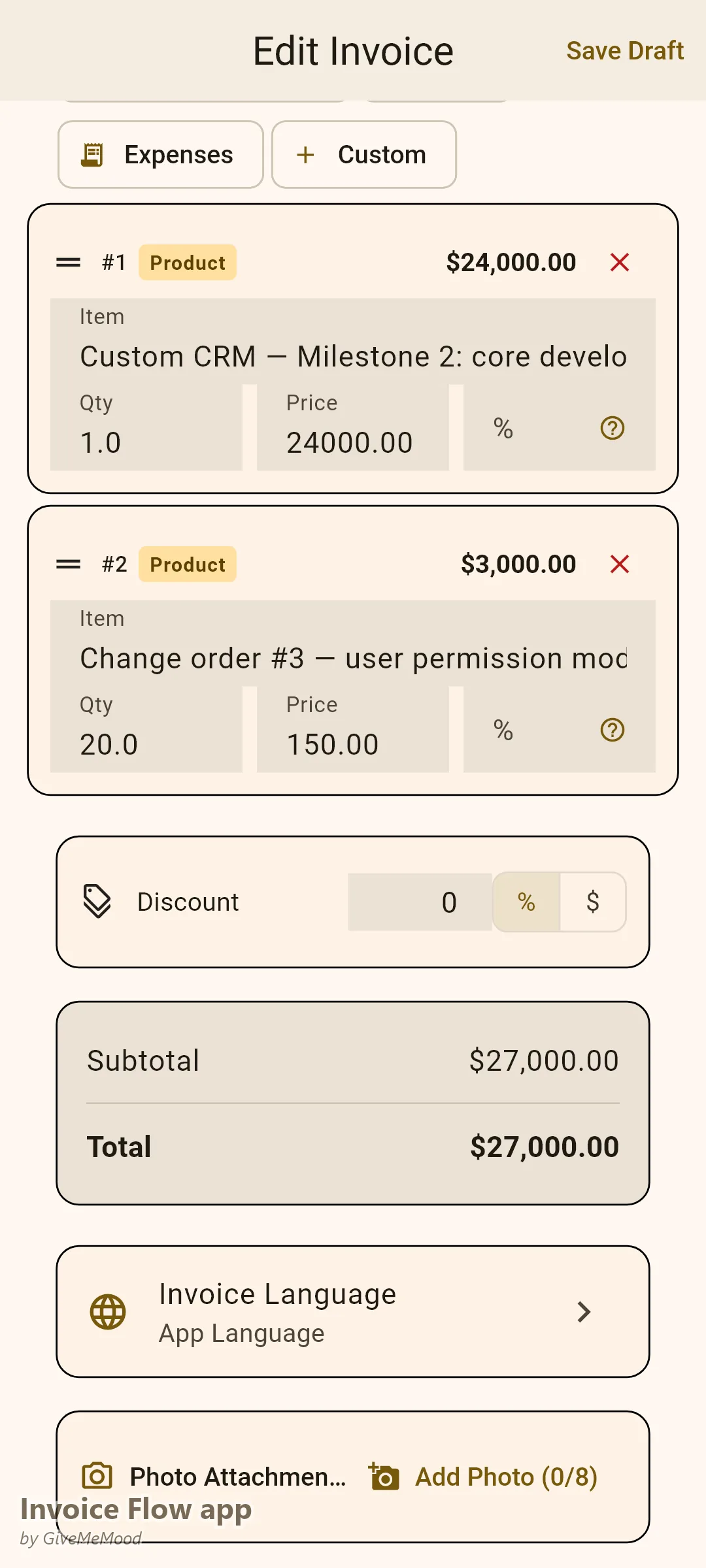
Requirements change in software projects. The professional response is a formal change request authorization invoice — issued before the work begins, not added to the final invoice as a surprise.
“Change Request Authorization — CR-2026-007: Description: Add two-factor authentication (SMS + email) to user login flow. Original SOW specified single-factor only.
- Backend authentication service modification: 12 hours × $175/hr: $2,100.00
- Frontend UI redesign for auth screens: 8 hours × $175/hr: $1,400.00
- QA and regression testing: 6 hours × $175/hr: $1,050.00 Total: $4,550.00
Authorization required before work commences. Estimated delivery: 5 business days after authorization.”
Track change requests sequentially (CR-2026-001, CR-2026-002, etc.) for each project. This documentation demonstrates exactly how the project scope evolved from original agreement to delivered product — useful for client relationships and essential for any dispute resolution.
Support and Maintenance Retainers
The highest-value billing action a software agency can take after project delivery is converting the client to a monthly support retainer. The timing is optimal: the client has just experienced your work and knows they need ongoing access.
Standard retainer tier structure:
Tier 1 — Essential (8 hours/month): Bug fixes, security patches, dependency updates, technical support response. $1,400/month.
Tier 2 — Active (16 hours/month): Above plus feature additions, performance optimization, API integrations, monthly code review session. $2,800/month.
Tier 3 — Dedicated (32 hours/month): Reserved capacity for ongoing development, all support levels, monthly architecture review, priority response SLA. $5,600/month.
Overage hours bill at your standard hourly rate, invoiced alongside the monthly retainer.
Set up recurring invoices in InvoiceFlow for each retainer client. The invoice generates on the first of each month and sends automatically. No manual action required.
Enterprise and Corporate Billing
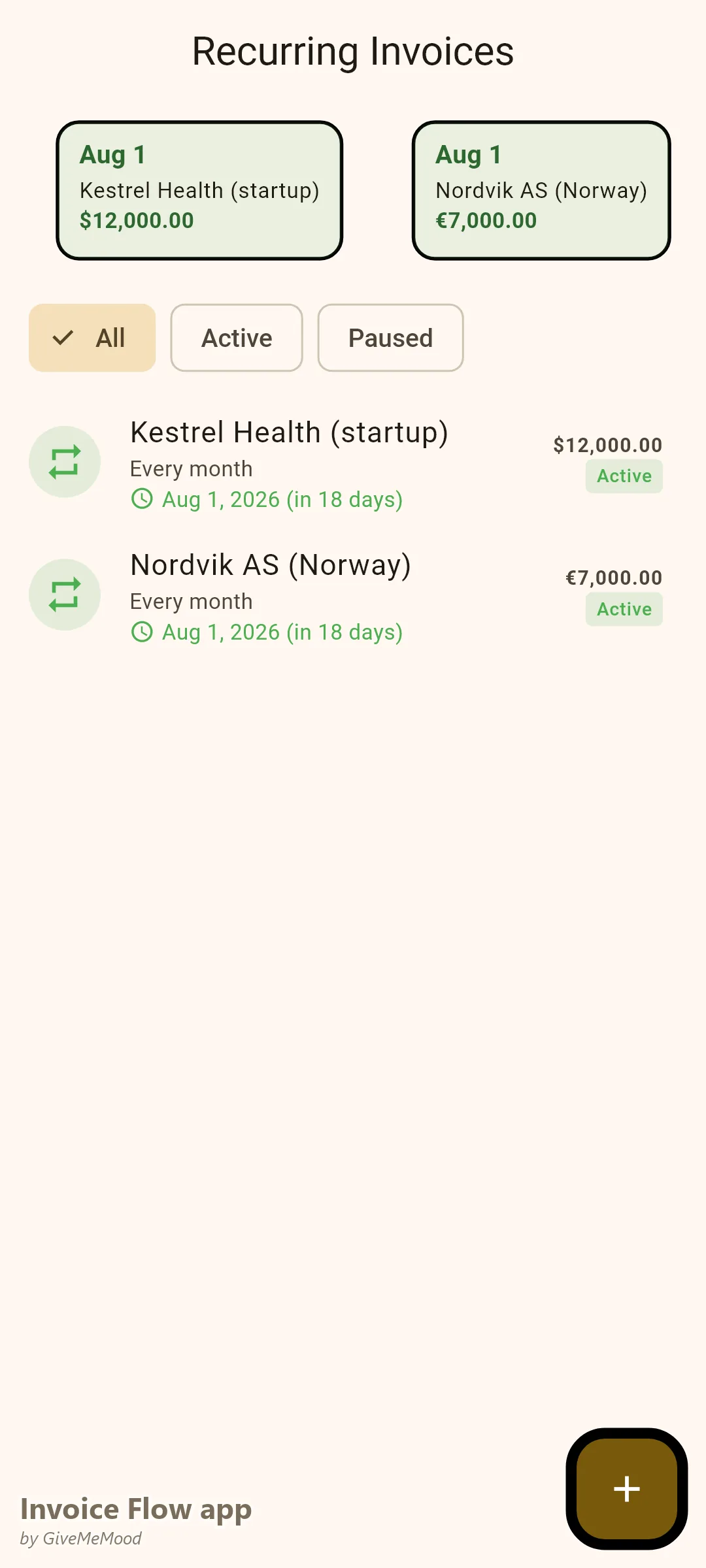
Enterprise procurement departments require specific fields on every invoice. Missing fields mean the invoice sits in an approval queue or gets returned for correction — delaying payment by weeks.
Required fields for enterprise invoices:
- Purchase Order (PO) Number
- Vendor/Supplier Registration Number
- Project Code or Cost Center
- Statement of Work reference
- Net-30 or Net-45 payment terms clearly stated
- Invoice due date
Add all of these as custom fields in InvoiceFlow. Apply them to every corporate invoice automatically.
“Software Development Services — [Enterprise Client] — [Month Year]: PO Number: PO-2026-IT-ENG-0921 Vendor Registration: VR-84421 Cost Center: DIGITAL-OPERATIONS SOW Reference: SOW-2026-ENT-007 Phase 3 deliverables: UAT environment, testing support, 14-issue bug sprint, performance report. Amount: $28,500.00 Payment Terms: Net-45 Due Date: [Date]”
The AP system matches invoice to PO. Payment releases without intervention.
Fixed-Price Product Builds
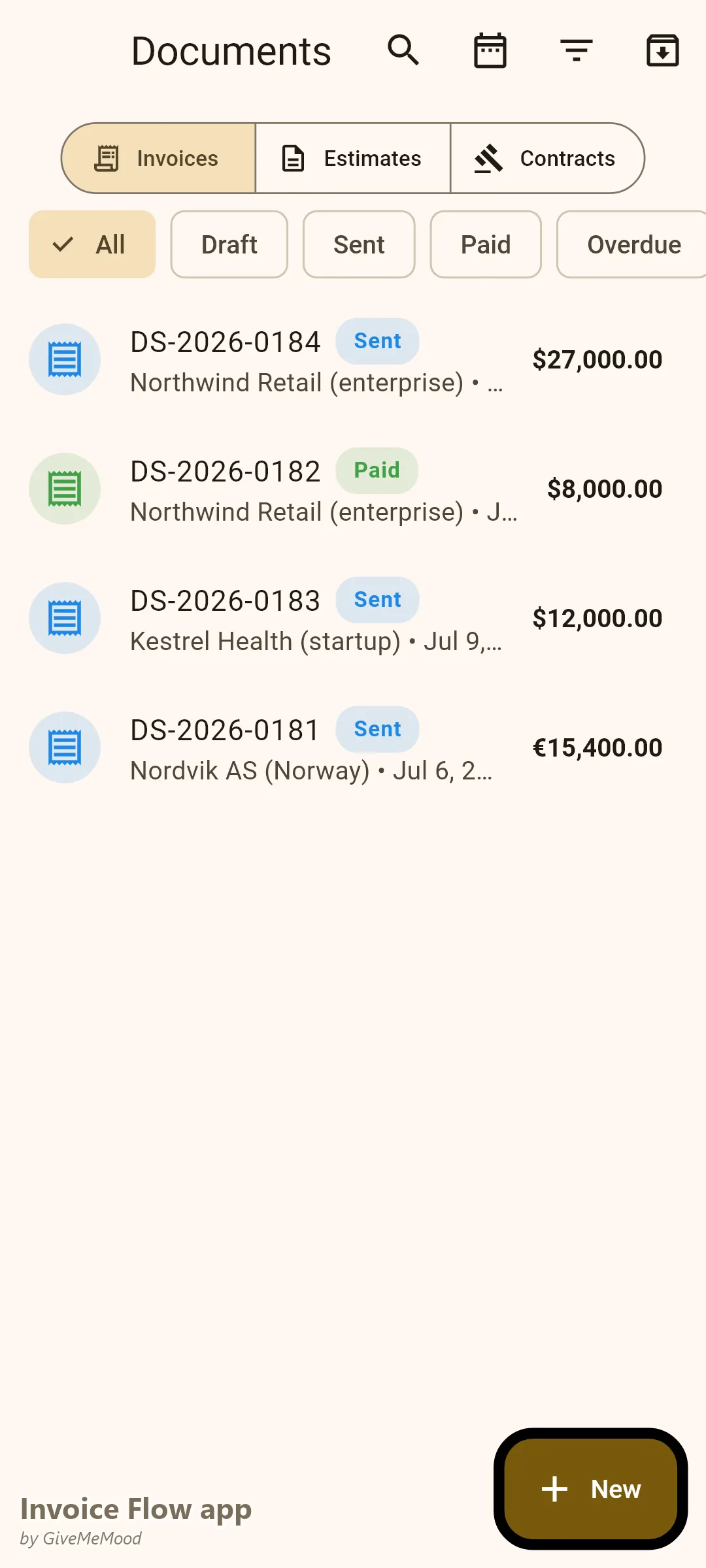
Some software projects are scoped as fixed-price deliverables rather than hourly work. These invoice cleanly as product line items:
“Mobile Application Development — [Client Name]:
- iOS and Android app (React Native): $18,000.00
- Backend API (Node.js + PostgreSQL): $7,500.00
- Admin dashboard (web): $4,500.00
- App store submission and deployment: $1,000.00
- 60-day post-launch bug warranty included Total: $31,000.00”
Fixed-price invoicing gives the client certainty. Your SOW defines exactly what is included. Change requests are documented separately when new requirements emerge.
What InvoiceFlow Does for Software Agencies
- Phase template creation: build milestone invoice templates at project kickoff, trigger each phase when the deliverable is complete
- SOW reference fields: add statement of work numbers and dates to every project invoice
- Change request tracking: issue numbered CR invoices before any out-of-scope work begins
- Recurring retainer invoices: monthly support agreements auto-generate and send without manual action
- Enterprise custom fields: PO numbers, vendor IDs, cost centers, project codes — all stored per client
- Payment tracking: outstanding project balances visible by phase and by client
Getting Started
- Map your current projects to phase milestones and create phase invoice templates for each
- Add SOW reference custom fields to your invoice template
- Set up recurring invoices for any current clients who need ongoing support
- Define your retainer tier pricing and present it at the next project handover
- Issue a change request invoice for the next out-of-scope request before you do the work
Download InvoiceFlow. Professional software billing is the foundation that turns project income into recurring agency revenue.
InvoiceFlow is a free invoicing app for Android, designed for independent professionals and small business owners.