
 EN
EN  العربية
  Български
  Čeština
  Dansk
Dansk  Deutsch
  Ελληνικά
  Español
  Suomi
Suomi  Français
  עברית
עברית  हिन्दी
  Bahasa Indonesia
  Italiano
  日本語
日本語  한국어
한국어  Bahasa Melayu
  Nederlands
  Norsk
Norsk  Polski
  Português
  Română
  Русский
  Svenska
  Kiswahili
  ไทย
ไทย  Türkçe
  Українська
  Tiếng Việt
  中文
中文 From Break-Fix Chaos to Managed Services: How I Transformed My IT Business with Professional Billing
By Alex Rivera, IT Support Specialist & MSP Owner — Minneapolis, MN
I started doing IT support on the side while working a corporate IT job. A friend needed help with his small business computers, I fixed them on a Saturday morning, and he gave me $150. That was 2019. By 2021 I had enough side clients that I went independent. By 2023 I was running a small managed services practice with twelve client businesses.
The path from corporate employee to independent IT professional to small MSP owner was exciting and exhausting in equal measure. What I did not anticipate — what nobody in the informal networks where I learned the business mentioned — was that my biggest growth problem would not be technical competence. It would be billing.
What Break-Fix Billing Actually Costs You
Break-fix billing is simple in theory: something breaks, you fix it, you send an invoice for the hours. In practice, for a one-person or small IT operation, it creates a cascade of problems that compound over time.
Problem one: delayed billing. When I finished a break-fix call, my priority was the next call or the other tasks I had queued. Invoicing would happen “later.” Later often meant the end of the day, or the end of the week, or when the client called to ask if they owed me anything. Work that was not invoiced promptly was sometimes not invoiced at all. I estimate I lost $200-$400 per month in unbilled small calls.
Problem two: disputed hours. When I did invoice, I was working from memory. I remembered arriving around 10 AM and leaving around 12:30, so I would bill 2.5 hours. Sometimes the client had a different recollection. Sometimes I was not sure myself. Without a timestamp and a clear record of what was done, small disputes were inevitable.
Problem three: no recurring income. The break-fix model means every month starts at zero. You have no idea how much money is coming in until the calls come in. You cannot plan, hire, or invest in the business because the income is completely unpredictable.
I recognized all three problems before I fully solved any of them. The solution to all three turned out to be the same: professional invoicing.
The First MSP Conversation That Went Right

About a year into my independent practice, I was doing break-fix support for a small accounting firm — five employees, aging laptops, a network setup that constantly caused problems. I was there regularly. They were effectively paying me monthly in aggregate but on a per-call, ad-hoc basis.
In a conversation with the owner about what her IT costs were running, she said something that stayed with me: “I never know what you’re going to cost me this month. It makes budgeting impossible.”
She was right. The unpredictability that bothered me from the income side was bothering her from the expense side. We both wanted predictability. The answer was a monthly managed services agreement.
I wrote up a simple MSP scope — remote monitoring, helpdesk access, monthly preventive maintenance visit, patch management — and quoted a flat monthly fee. She said it sounded reasonable but wanted to see a formal invoice first.
I used InvoiceFlow to create the first monthly invoice: “Managed IT Services — Prescott Accounting Group — June 2026: 5 workstations, remote monitoring and response, helpdesk up to 4 hours monthly, monthly maintenance visit. Monthly fee: $675.”
She paid it within three days. The following month, I sent the recurring invoice that generated automatically. She paid it within two days. We have been on that same arrangement for over two years.
Rebuilding the Break-Fix Billing Process
After the MSP success, I returned to my break-fix clients and rebuilt how I invoiced that work too.
The new process: before I leave the client site, I open InvoiceFlow on my phone and create the invoice. Not when I get home. Not at the end of the day. Before I leave.
The invoice includes:
“IT Support Call — [Client Name] — June 8, 2026:
- Remote Desktop Troubleshooting — Outlook configuration and email server settings: 1.5 hours × $110/hr: $165.00
- Hardware Inspection — RAM stress test, thermal check: 0.5 hours × $110/hr: $55.00
- Travel Time (one way) — 12 miles: $22.00 Total: $242.00”
I create this while the details are fresh. The client can see exactly what they paid for. There are no hours disputes because I document what I did, not just how long I was there. And I have not had an invoice sit unpaid longer than a week since I implemented this process.
Hardware Sales: The Documentation That Protects Everyone
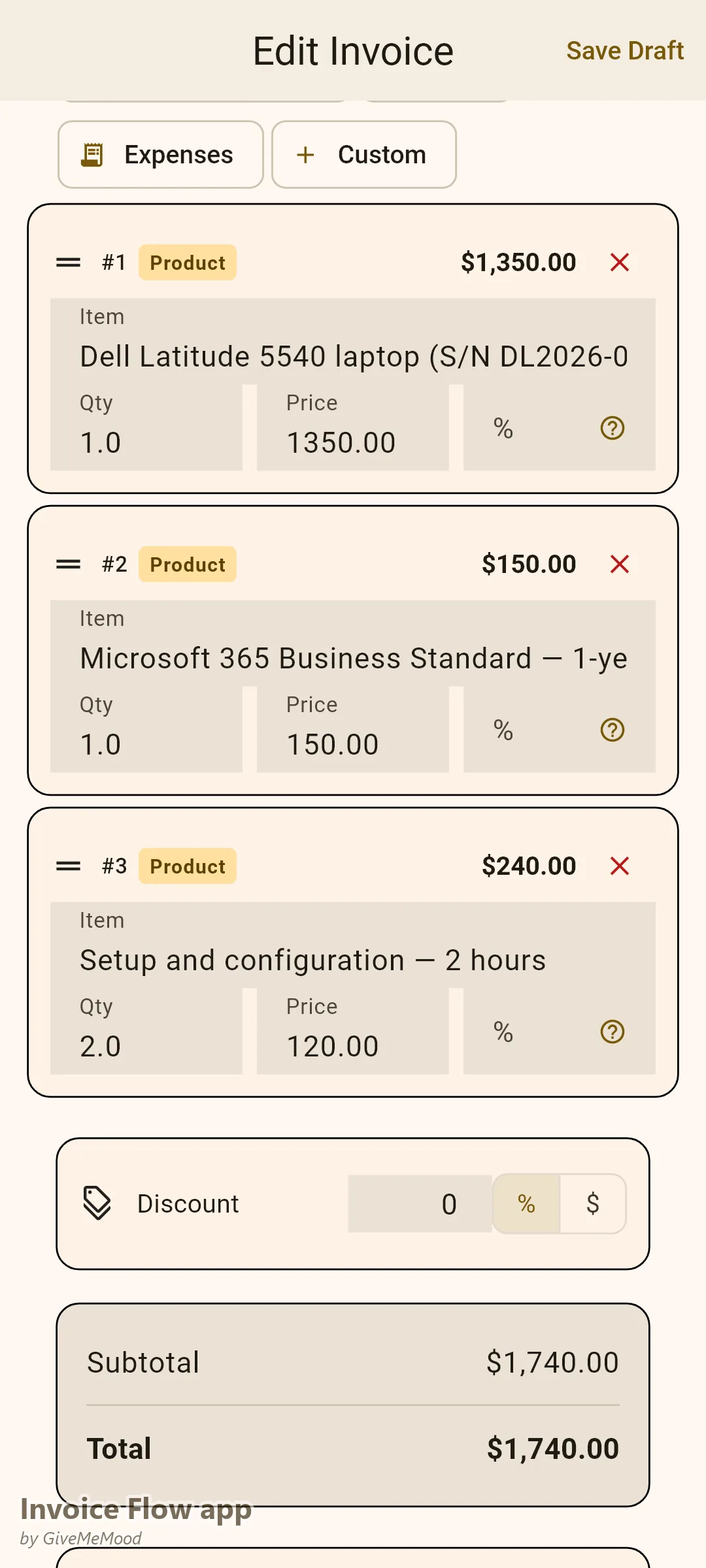
IT hardware sales are a part of every technician’s practice — buying equipment for clients, sourcing replacement parts, recommending and procuring upgrades. Before InvoiceFlow, I invoiced hardware the way I invoiced service: roughly and late.
This created real problems. A client would buy a laptop through me; six months later, it would have a warranty issue. Without a clear invoice showing the serial number, purchase date, and model details, the warranty claim process was a headache.
Now every hardware invoice includes:
“Hardware Procurement — [Client Name] — June 2026:
- Lenovo ThinkPad E16 (S/N: LNV2026-87341) — 16GB RAM, 512GB SSD: $1,280.00
- Windows 11 Pro OEM License (Key: XXXXX-XXXXX-XXXXX-XXXXX): $189.00
- Hardware Configuration and Setup — 2 hours × $110/hr: $220.00
- 3-Year Manufacturer Warranty Extension: $180.00 Total: $1,869.00”
The client has a record for their asset tracking. I have a record for warranty support. The documentation serves both of us.
Corporate Client Ticket Integration

About two years into my practice, I started winning corporate clients — small companies with IT departments that used helpdesk ticketing systems. These clients had specific billing requirements: every invoice needed to reference the IT support ticket that originated the work.
This was a straightforward problem to solve with InvoiceFlow’s custom fields. I add a “Ticket Reference” field to every corporate invoice, linking my billing to their helpdesk record.
“IT Support — [Corporate Client] — June 2026: Ticket #: IT-2026-04891 — Server room temperature alarm investigation and HVAC contractor coordination: 3.5 hours × $125/hr: $437.50. Ticket Reference: IT-2026-04891.”
The corporate AP team processes these without follow-up because my invoice matches their internal records. Payment arrives within terms. No queries, no delays, no chasing.
The Transformation in Numbers
Before the MSP transition and billing overhaul, my monthly income was highly variable — somewhere between $2,800 and $7,500 depending on how many calls came in. I had no reliable way to forecast what any given month would bring.
After implementing InvoiceFlow and converting clients to MSP agreements where possible:
- Six of my twelve clients are now on monthly MSP agreements, generating approximately $4,200 per month in predictable recurring revenue
- My break-fix billing has become efficient enough that I rarely miss an invoice
- My effective collection rate on invoices sent through InvoiceFlow is near 100%
- My monthly income floor is now approximately $5,800, with additional break-fix and project income on top
The transformation was not from getting more clients. It was from billing properly for the clients I already had.
What the Practice Looks Like Now
Twelve client businesses, six on MSP agreements, the remainder on break-fix with structured invoicing. Two corporate clients with ticket-referenced billing. Hardware and software procurement invoiced with full documentation. Project work — network installations, server setups — billed by phase.
The practice I run today is a real business with predictable income and professional billing. The break-fix chaos of year one is not something I miss.
Download InvoiceFlow. Set up your service catalog. Convert your first break-fix client to a monthly MSP agreement this week. Build the recurring income foundation your business needs.
Alex Rivera is an IT support specialist and MSP owner in Minneapolis, Minnesota, serving small and mid-size businesses across the Twin Cities metro area.