
 EN
EN  العربية
  Български
  Čeština
  Dansk
Dansk  Deutsch
  Ελληνικά
  Español
  Suomi
Suomi  Français
  עברית
עברית  हिन्दी
  Bahasa Indonesia
  Italiano
  日本語
日本語  한국어
한국어  Bahasa Melayu
  Nederlands
  Norsk
Norsk  Polski
  Português
  Română
  Русский
  Svenska
  Kiswahili
  ไทย
ไทย  Türkçe
  Українська
  Tiếng Việt
  中文
中文 InvoiceFlow for Cybersecurity Consultants: Complete Billing Guide
The invoicing system built for independent security consultants, penetration testers, and managed security practices
Cybersecurity consulting billing requires precision. You may invoice planned assessments, unplanned incident response, ongoing monthly retainers, regulatory compliance engagements, and one-time training sessions — all with different rate structures, payment terms, and documentation requirements.
InvoiceFlow handles every cybersecurity billing type from one Android app. This guide covers how to structure each invoice type professionally.
Assessment and Audit Milestone Billing
Security assessments are your highest-value engagements. Billing them as a single invoice at completion creates a 30-60 day cash flow gap while you do the most intensive work. The professional structure is three milestones.
Standard assessment billing phases:
Milestone 1 — Engagement Deposit (40%): Due upon signed engagement agreement and statement of work. Covers kick-off meeting, scope confirmation, tool deployment, access provisioning, initial reconnaissance.
Milestone 2 — Assessment Completion (35%): Due upon delivery of preliminary findings report to client. Covers all active testing, vulnerability scanning, configuration review, interview sessions, initial findings.
Milestone 3 — Final Report and Briefing (25%): Due upon delivery of final report and executive briefing. Covers final report compilation, remediation priority matrix, executive summary, briefing session.
Apply Net-15 terms to each milestone. This means you receive payment throughout the engagement rather than at the end.
Reference your statement of work on every milestone invoice: “Milestone 2 as defined in Engagement SOW-2026-SEC-004, dated January 10, 2026.”
Penetration Test Billing
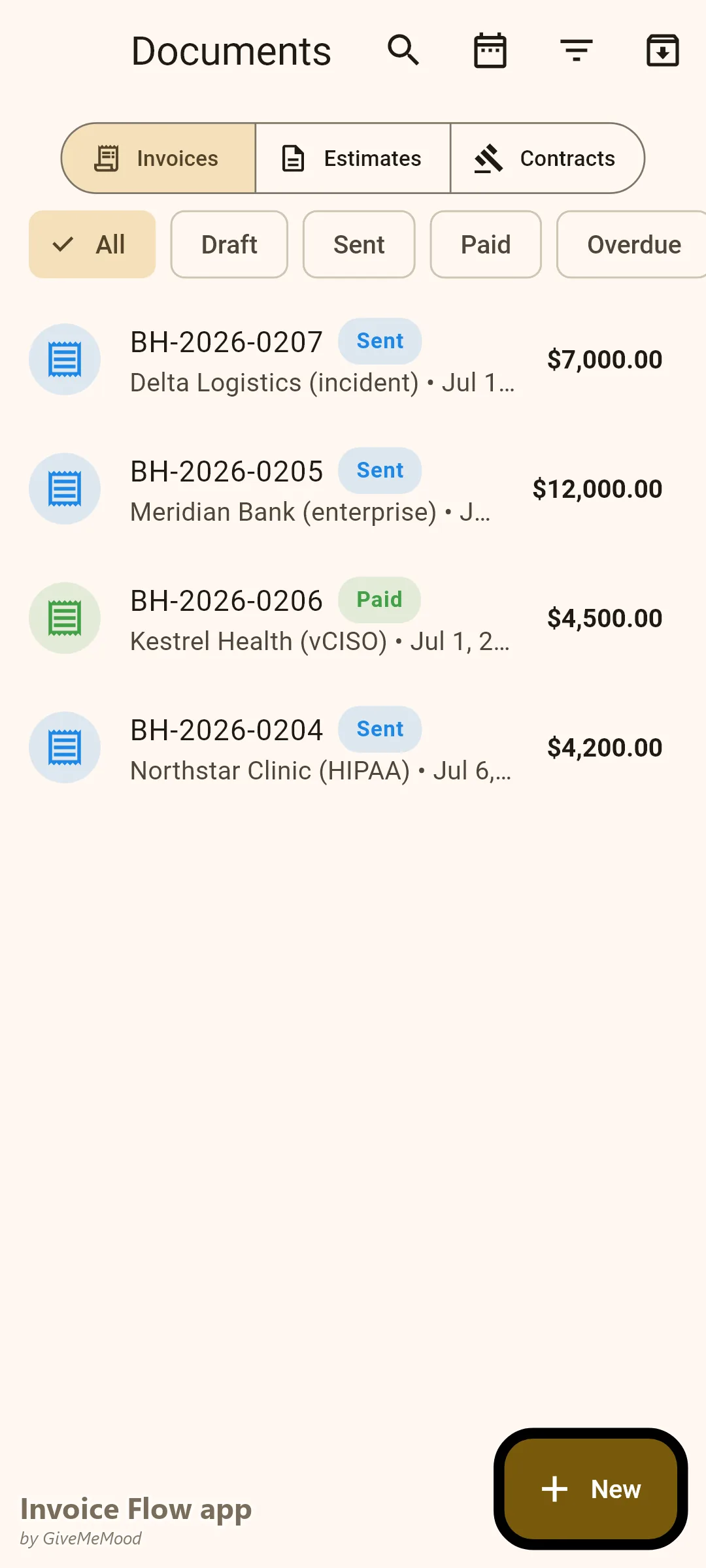
Penetration test engagements typically have a defined scope that warrants their own invoice structure. Document all components explicitly:
“Penetration Testing Engagement — [Client Name]:
- External network penetration test (IP range: 203.0.113.0/24): $4,800.00
- Web application penetration test (3 applications): $6,200.00
- Internal network assessment (post-initial-access simulation): $3,500.00
- Social engineering phishing simulation (50 users): $2,200.00
- Final report and remediation roadmap: included Total: $16,700.00 Milestone deposit (40%): Due at engagement start: $6,680.00”
Itemizing penetration test components gives clients visibility into how the engagement is structured — and makes scope expansions easy to price and document separately.
Monthly Security Retainer Invoices
Post-assessment retainer programs are the revenue foundation of a sustainable cybersecurity consulting practice. Present a retainer after every assessment while the client has fresh findings and no implementation path.
Standard retainer tiers:
Essential (8 hours/month): Monthly vulnerability scan review, critical findings remediation guidance, security patch advisory, incident response on-call access. $1,600/month.
Active (16 hours/month): Above plus monthly security awareness training session, quarterly phishing simulation, policy review and updates, vendor security questionnaire support. $3,200/month.
Comprehensive (24 hours/month): Above plus monthly executive risk briefing, continuous monitoring support, regulatory compliance tracking (HIPAA/SOC2/PCI-DSS), board-level risk reporting. $4,800/month.
Set up recurring invoices in InvoiceFlow for each retainer client. They generate and send automatically on the first of the month. Define overage terms clearly: additional hours billed at your standard hourly rate on the same monthly invoice.
Incident Response Billing
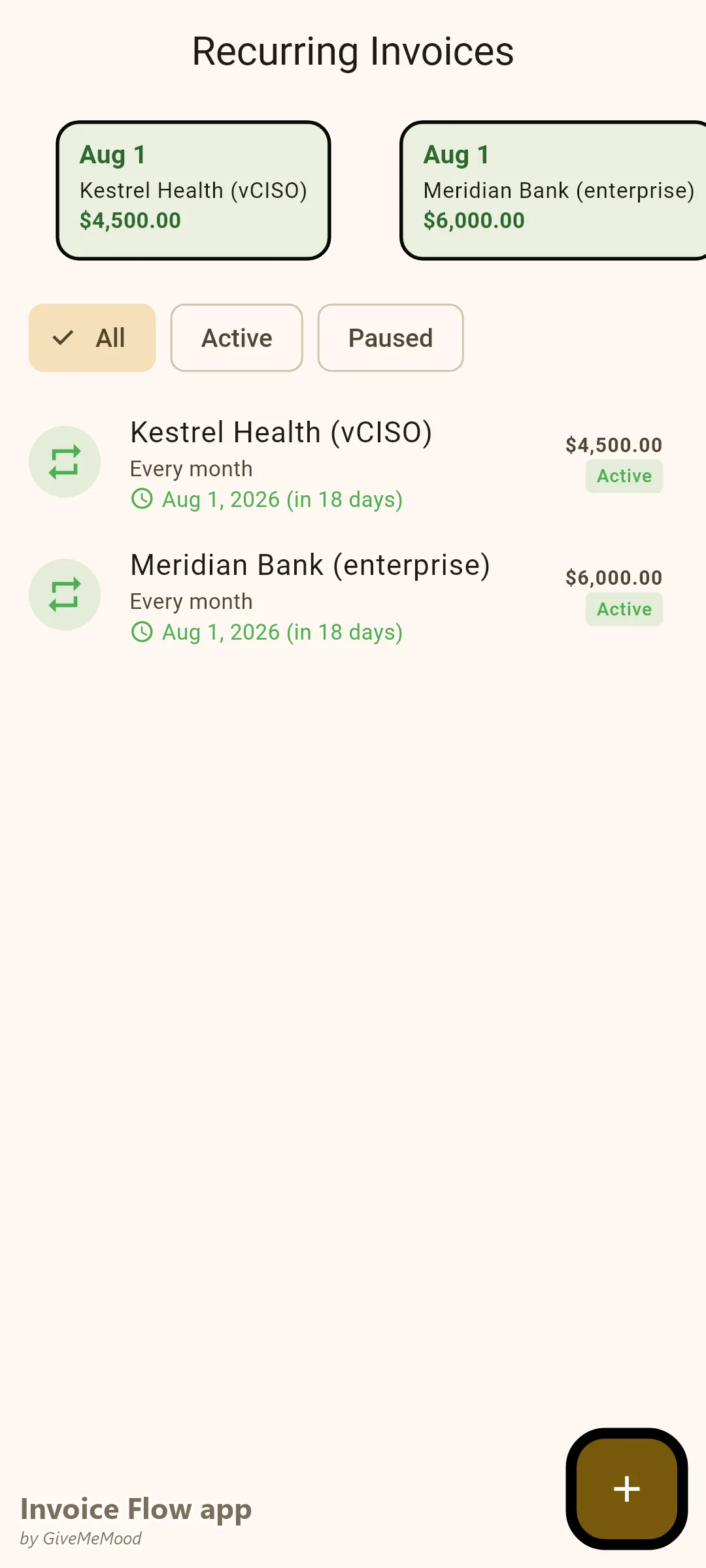
Incident response work requires a distinct billing approach: premium hourly rate, phase documentation, short payment terms, and transparent surcharges for emergency and after-hours engagement.
“Incident Response Services — [Client Name] — IR-2026-008: Phase 1 — Initial Triage and Containment (Day 1, 8 hours × $275/hr): $2,200.00 Phase 2 — Forensic Analysis (2 analysts × 6 hours × $275/hr): $3,300.00 Phase 3 — Eradication and Recovery (4 hours × $275/hr): $1,100.00 Phase 4 — Post-Incident Documentation and Briefing (3 hours × $275/hr): $825.00 Weekend/after-hours emergency surcharge: $750.00 Total: $8,175.00 Payment Terms: Net-7”
Net-7 terms are standard and accepted in IR billing. Clients engaging emergency response understand the urgency extends to payment. Document the surcharge openly — it is a legitimate and expected line item for after-hours response.
Compliance Consulting Invoices
Regulatory compliance engagements (HIPAA, SOC 2, PCI-DSS, CMMC) require documentation that maps to the client’s compliance framework. Include framework references directly on the invoice.
“Cybersecurity Compliance Consulting — [Client Name]: Compliance Framework: HIPAA Security Rule (45 CFR Part 164) Engagement Type: Security Risk Analysis per §164.308(a)(1) Deliverables:
- Network vulnerability assessment: $4,200.00
- Access control gap analysis: $2,800.00
- Workforce training session (2 hours, all staff): $1,400.00
- Risk assessment documentation package: $2,200.00
- Remediation priority matrix: included Total: $10,600.00 SOW Reference: SOW-2026-HC-019 PO Number: PO-2026-COMP-041”
This documentation creates a billing trail that also supports the client’s own compliance documentation. For regulated-industry clients, the invoice itself becomes part of their audit evidence.
Security Training Invoices
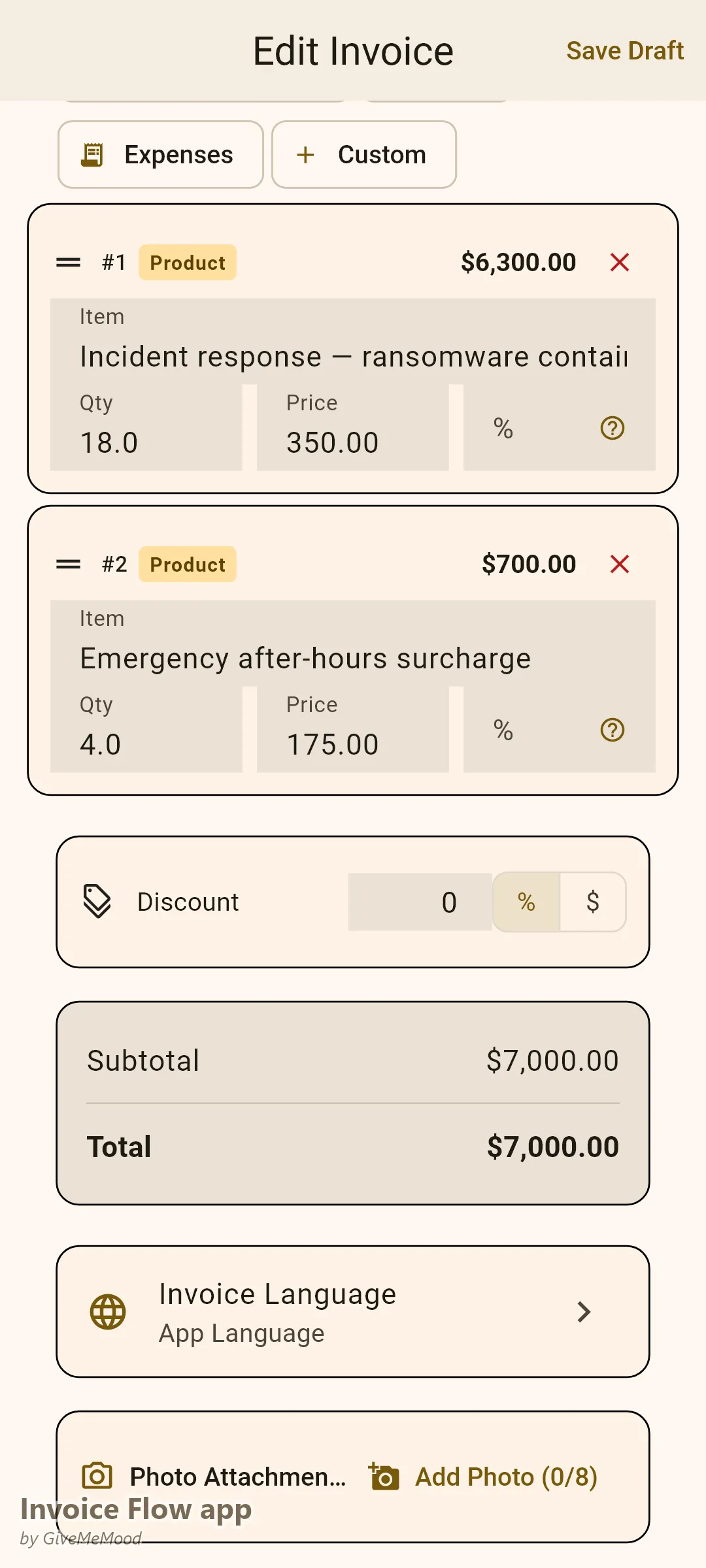
Security awareness training is a billable service that many consultants undercharge or deliver without formal invoicing. Structure it with clear deliverables:
“Security Awareness Training — [Client Name]:
- Phishing simulation design and execution (50 employees): $1,200.00
- Security awareness workshop (2-hour facilitated session): $1,800.00
- Post-training assessment and reporting: $600.00
- Training materials and documentation package: $400.00 Total: $4,000.00”
What InvoiceFlow Does for Cybersecurity Consultants
- Milestone invoice templates: build all assessment phase invoices at engagement start, trigger each when the milestone is reached
- SOW and engagement reference fields: link every invoice to the signed engagement agreement
- Recurring retainer invoices: monthly security programs auto-generate and send
- Compliance documentation fields: add framework references, regulation citations, and audit-trail notes to regulated-industry invoices
- Custom fields: PO numbers, vendor IDs, cost centers for corporate and government clients
- Payment terms control: set net-7 for IR, net-15 for assessments, net-30 for ongoing retainers — per client
Getting Started
- Define your standard engagement rates and retainer tier pricing
- Build a three-milestone invoice template for assessment engagements
- Create a retainer proposal to present after your next completed assessment
- Set up recurring invoices for any current clients receiving ongoing services
- Add compliance documentation fields for any regulated-industry clients
Download InvoiceFlow. Professional cybersecurity billing protects your cash flow and signals the same competency your technical work delivers.
InvoiceFlow is a free invoicing app for Android, designed for independent professionals and small business owners.