 EN
EN  العربية
  Български
  Čeština
  Dansk
Dansk  Deutsch
  Ελληνικά
  Español
  Suomi
Suomi  Français
  עברית
עברית  हिन्दी
  Bahasa Indonesia
  Italiano
  日本語
日本語  한국어
한국어  Bahasa Melayu
  Nederlands
  Norsk
Norsk  Polski
  Português
  Română
  Русский
  Svenska
  Kiswahili
  ไทย
ไทย  Türkçe
  Українська
  Tiếng Việt
  中文
中文 How I Scaled from 5 to 40 Properties Without Hiring a Bookkeeper
By Grace Martinez, Independent Property Manager — Portland, OR
Property management sounds simple from the outside. You manage a property. The owner pays you a percentage of the rent. You coordinate maintenance when something breaks. You find tenants when one leaves. How complicated can the billing be?
The answer — which I discovered painfully over three years of growing my portfolio — is very. Property management billing is not one transaction. It is dozens of recurring transactions, maintenance pass-throughs, lease administration fees, and owner statements that have to be generated, sent, tracked, and reconciled every single month. For every property. Without exception.
When I was managing five properties, I could do this manually. It was inefficient, but manageable. When I was managing twenty-two properties, I was spending every Monday generating invoices, creating maintenance statements, chasing late payments, and reconciling my accounts. I was working thirty to forty hours per month on billing alone — billing for a business that was supposed to be largely passive income from management fees.
The billing overhead was eating the business.
What Property Management Billing Actually Looks Like
Before I explain the solution, I want to be specific about the problem, because I think most people outside of property management underestimate the complexity.
For each property I manage, every month, I need to:
- Calculate the management fee based on rent collected (typically 8-10% of monthly rent)
- Create an invoice for that management fee
- Document any maintenance or repair costs with supporting invoices from contractors
- Apply any coordination markup I charge on maintenance (typically 10-15%)
- Create a maintenance pass-through statement for the owner with all costs itemized
- Generate a rent receipt for the tenant if they request one
- Track all of this in a way that produces clean year-end income documentation
Multiply that by twenty, thirty, or forty properties. Do it every month without error. Do it in a way that property owners — many of whom are sophisticated investors who scrutinize every line item — will accept without questioning.
That is the reality of property management billing at scale.
The System That Was Failing
In my first three years, I used a combination of Excel templates and a Word-based invoice that I modified for each property every month. It worked for five properties. It started showing cracks at ten. By fifteen properties, I was making errors — billing the wrong amount, duplicating charges, missing items — that were causing friction with property owners.
The friction was not just inconvenience. Property owners who question your invoices lose confidence in your management. Twice in my first three years, I lost a property because the owner felt my billing was “disorganized.” The actual management of the properties was good. The billing created the perception that I was not professional.
I lost those properties because my invoicing could not keep pace with my portfolio.
Setting Up InvoiceFlow: The Eight-Hour Saturday
I found InvoiceFlow and spent one Saturday — about eight hours — migrating my entire billing system.
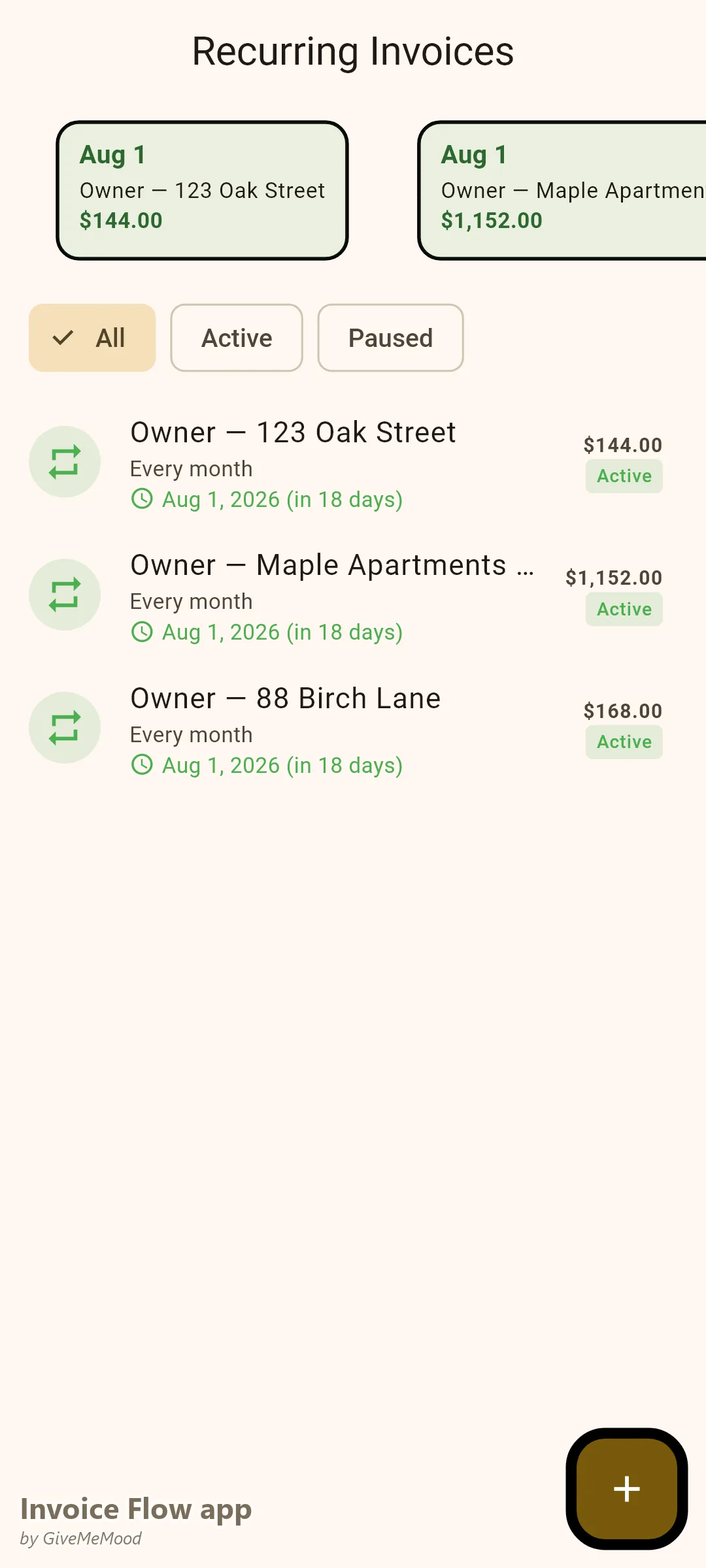
I created a client profile for each of my twenty-two properties at the time, with the owner’s information, the property address, the management fee percentage, and the monthly rent amount. I set up recurring invoices for each property: management fee calculated against the standard rent, due on the first of each month, auto-generated and ready to review before sending.
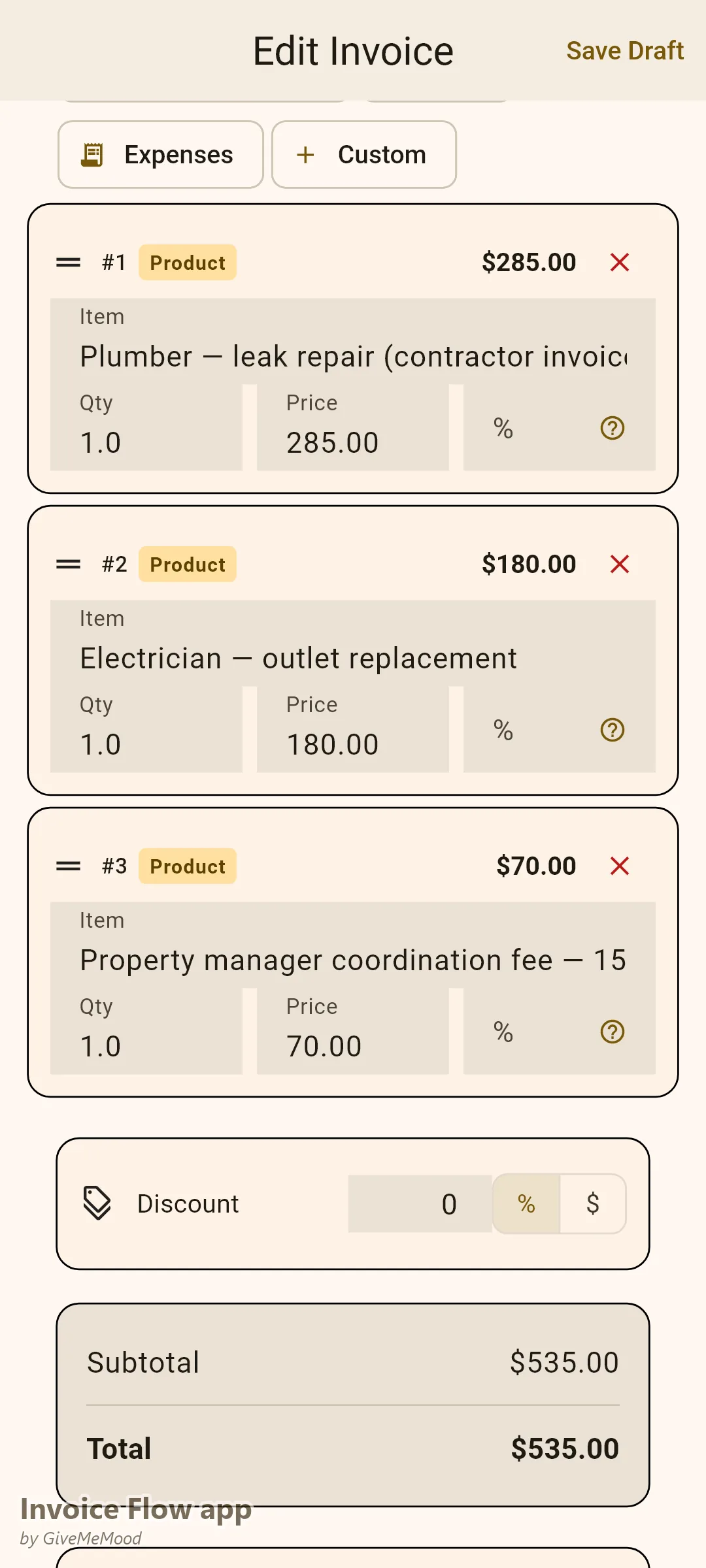
I built a maintenance pass-through template with my standard markup line item already in the structure. For each maintenance event, I add the contractor charges, my markup calculates automatically, and a professional itemized statement goes to the owner.
The first month after setup: I reviewed and sent all twenty-two management fee invoices in about ninety minutes, compared to approximately eight hours in my previous system. The maintenance statements that month — there were six — took about twenty minutes each to prepare versus forty to sixty minutes.
The time savings were immediate and significant.
The Maintenance Pass-Through That Eliminated Disputes
The most valuable specific change was the maintenance pass-through invoice format.
Previously, I would email owners an informal statement: “Had the plumber out this month for the water heater — $340. Adding my coordination fee — $45. Total: $385.” This was better than nothing, but it created conversations. Owners would ask for the original contractor invoice. Sometimes I had it, sometimes I had to chase the contractor. Sometimes the numbers did not add up exactly as the owner expected.
Now the maintenance pass-through statement looks like:
“Maintenance Summary — 847 Maple Street — March 2026:
- Plumbing Repair — water heater element replacement (ABC Plumbing invoice attached): $340.00
- Electrical — GFCI outlet repair, kitchen (Northwest Electric invoice attached): $165.00
- Routine Inspection — semi-annual property inspection: $75.00
- Property Management Coordination Fee (12% of service total): $69.60 Total Maintenance and Coordination: $649.60”
The owner receives this with the original contractor invoices attached as PDFs. Every number is traceable to a source document. There is nothing to dispute because every cost is documented.
Since implementing this format, I have had zero maintenance billing disputes. Not lower disputes — zero. The documentation eliminates the ambiguity that disputes require.
The Rent Receipts That Became a Competitive Advantage
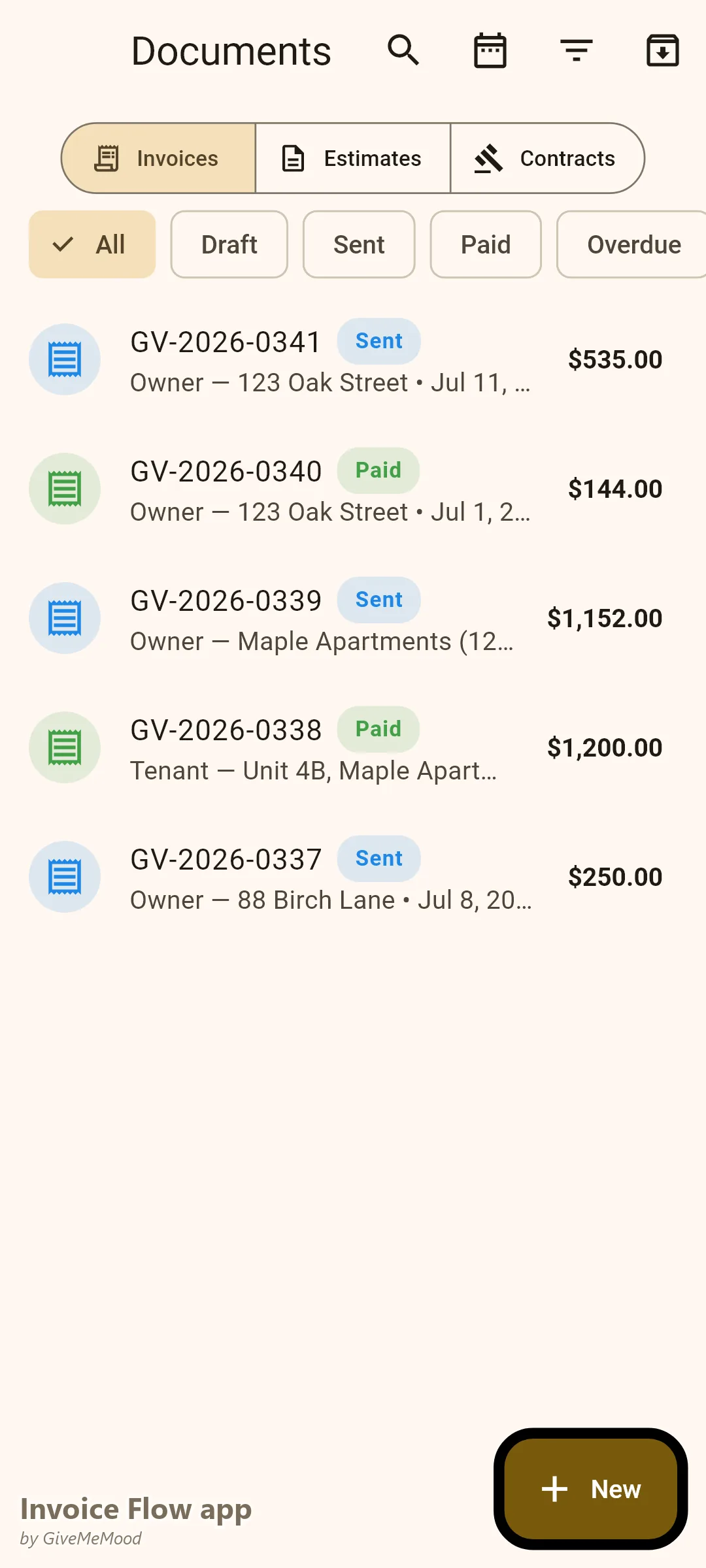
An unexpected benefit of InvoiceFlow was professional rent receipts. I had not thought much about this service before — tenants paid rent, I collected it, the owner received their proceeds, done. But about six months into using InvoiceFlow, I realized that many tenants needed documentation of their rent payments for purposes beyond just keeping track of their finances.
Tenants apply for mortgages, for which proof of rental payment history is often required. They apply for benefit programs that require proof of housing costs. They claim home office deductions. They have accountants who want clean records. They need documentation I had never offered to provide.
When I started proactively offering professional rent receipts — “If you ever need a formal receipt for any purpose, just let me know and I can have one to you in a few minutes” — the response was remarkable. Almost every tenant asked for receipts at some point. Several specifically mentioned that my proactive offer had made them feel better about the property and the management.
A professional rent receipt takes me about four minutes to generate in InvoiceFlow. The value to the tenant is disproportionate to the effort. And the goodwill it generates — the sense that I run a professional, organized operation — keeps quality tenants longer.
Growing to Forty Properties
By the time I was managing thirty properties, the billing was taking about three hours per month in total — a dramatic improvement from the thirty to forty hours I was spending at twenty-two properties with my old system. The efficiency gains came entirely from the automated recurring invoices and the template-based maintenance statements.
When I hit forty properties — which happened about eighteen months after implementing InvoiceFlow — I had to hire part-time administrative help for other aspects of the business (tenant communication, maintenance coordination, leasing activity) but not for billing. The billing system scales without additional labor.
The other thing that scaled was my reputation. Property investors talk to each other. In the Portland real estate investment community, I developed a reputation for professional documentation — owners received clear, itemized statements every month, maintenance costs were fully traceable, and any question they had could be answered by pulling up an invoice. Two of my largest accounts — owners with four and six properties each — came to me specifically because other investors recommended my billing as professional.
In property management, billing quality is visible. It is part of the service. Owners who receive professional, accurate, consistent documentation trust you more and stay longer.
What the Business Looks Like Now
Forty-three properties under management. Recurring invoices for all of them, auto-generated monthly. Maintenance pass-throughs with full documentation. Professional rent receipts available on request. Year-end analytics that show management fee income, maintenance coordination income, and lease administration income all clearly categorized.
The billing system I built in one eight-hour Saturday supports a business that generates consistent, predictable management income — and that has not lost a property to billing-related dissatisfaction since I implemented it.
Download InvoiceFlow. Set up your properties as client profiles. Configure your recurring management fee invoices. Build your maintenance pass-through template. Never spend another Monday on billing.
Grace Martinez is an independent property manager in Portland, Oregon, managing a portfolio of forty-three residential and small commercial properties across the greater Portland metropolitan area.