
 EN
EN  العربية
  Български
  Čeština
  Dansk
Dansk  Deutsch
  Ελληνικά
  Español
  Suomi
Suomi  Français
  עברית
עברית  हिन्दी
  Bahasa Indonesia
  Italiano
  日本語
日本語  한국어
한국어  Bahasa Melayu
  Nederlands
  Norsk
Norsk  Polski
  Português
  Română
  Русский
  Svenska
  Kiswahili
  ไทย
ไทย  Türkçe
  Українська
  Tiếng Việt
  中文
中文 The Cash Flow Problem That Almost Ended My Architecture Practice
By Robert Chen, AIA, Principal — Chen Architecture, Boston, MA
I founded my architecture practice at thirty-four after a decade working at a large firm where I learned how to design buildings. What I did not learn at that firm — because the billing was handled by someone else — was how to keep a practice financially solvent across long project timelines.
My first year of independent practice almost ended before it began.
The project that nearly broke me was a residential addition for a family in Newton — not a large project, about $220,000 in construction value, a standard design fee of approximately $22,000. I had signed the contract in January. I was billing monthly for hours worked. By June, I had billed approximately $8,000 against a total fee of $22,000 and was burning through my reserves because the monthly billing was not keeping up with my actual time commitment.
The project was going fine. The design was good. The client was happy. But my practice was running out of money because of how I was billing.
Understanding the Real Problem
The problem was structural, not incidental. Architecture projects are long. A residential addition from initial design through construction administration might span eighteen months to two years. During that time, a practitioner is investing substantial hours — in initial design, in development, in documentation, in coordination — that do not generate revenue until the invoice goes out and the client pays.
Monthly billing for hours worked sounds reasonable. In practice, it creates a cash flow mismatch on projects that front-load design work. I was doing most of the creative and intellectual work in the first four months of the project and then spending the remaining twelve months in administration and oversight. Billing evenly across those sixteen months underpaid me during the front half and somewhat overpaid me during the back half.
The other problem with hourly billing on architecture projects is that clients do not like it. They feel like they are watching a meter run. Every question they ask, every revision they request, every conversation about the project increases the bill in a way that is difficult for them to predict and budget for.
Phase-based billing — where the fee is divided across professional phases, each with a defined percentage of the total fee — solves both problems simultaneously. It distributes cash flow in a way that matches when the work happens. And it gives clients a predictable payment schedule tied to milestones they understand.
Rebuilding the Billing Approach
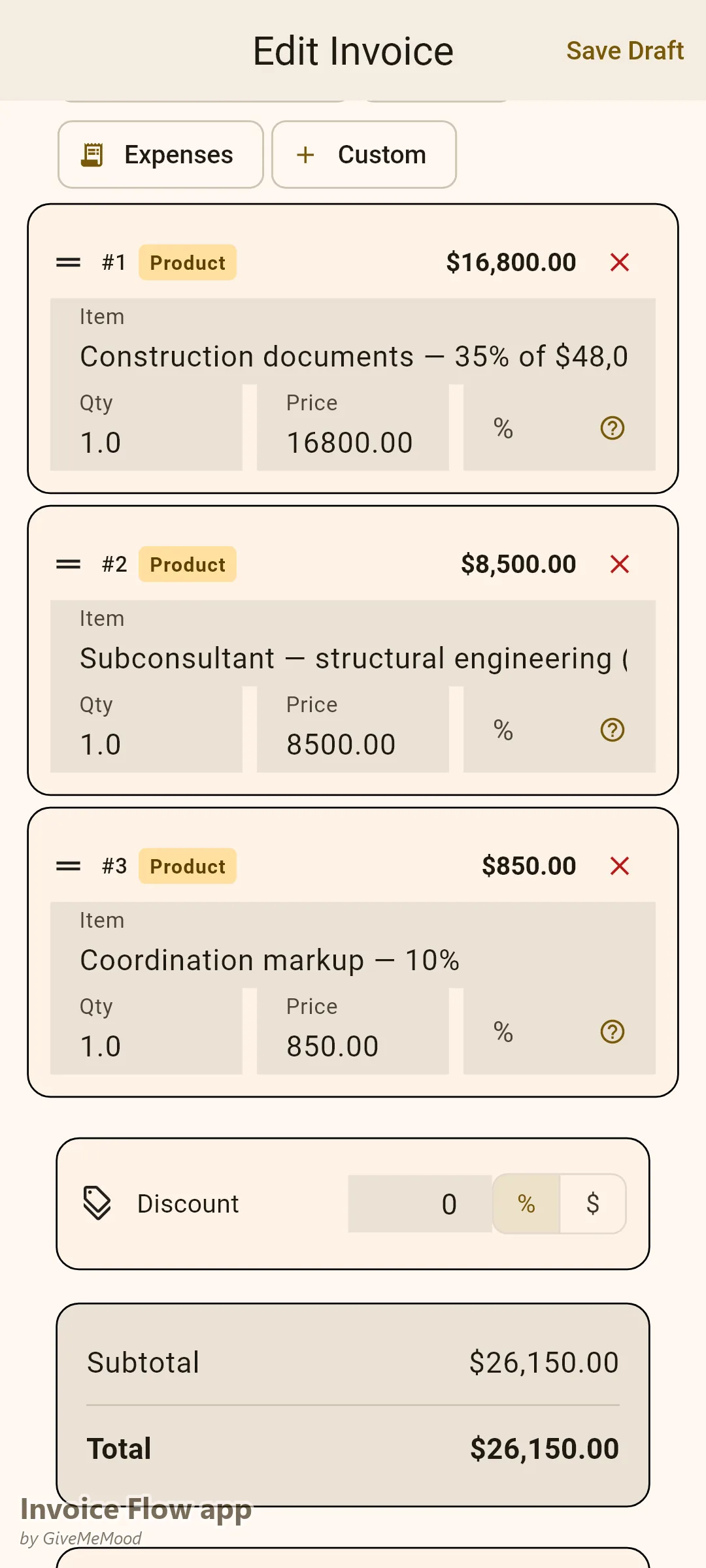
After that first painful year, I rebuilt my billing approach around the AIA’s standard phase structure:
Schematic Design (20% of total fee): This is when the big ideas happen — the concept, the massing, the spatial organization. Heavy creative investment. Billed at commencement and completion of this phase.
Design Development (20%): Refining the design, developing details, integrating structural and mechanical systems. Another period of intensive work.
Construction Documents (35%): The largest phase by fee, because it is the most labor-intensive. Drawings and specifications that the contractor will use to build.
Bidding and Negotiation (5%): Managing the bid process. Relatively light but important.
Construction Administration (20%): Oversight during construction. Spread across the construction duration, often billed monthly within the phase.
I set up InvoiceFlow and built these phases as a project billing template. Every project starts with a signed contract, a fee schedule that shows these phases, and a Phase 1 invoice issued at project commencement.
The first project I ran through this structure — a new construction residential project in Brookline, $380,000 construction value, $42,000 design fee — felt completely different from the perspective of cash flow. I received $8,400 at project start. I received $8,400 at the end of schematic design. I received $14,700 at the end of construction documents. The money was coming in at points where I had done the work that warranted it.
The Reimbursable System That Recovered Real Costs
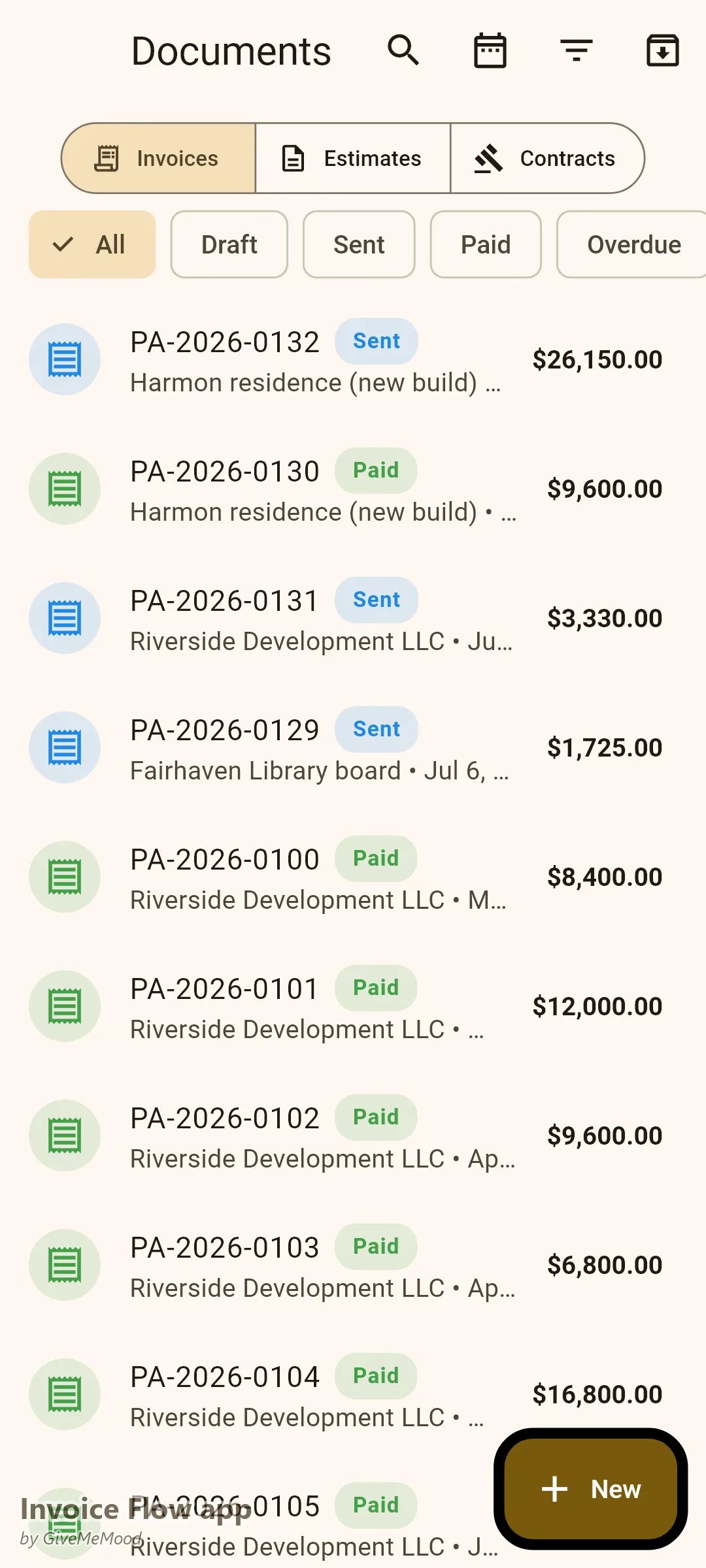
In my first year, I absorbed reimbursable expenses — printing and plotting, permit fees, site visit travel, model building — without invoicing for them. I did not have a clean way to present these costs, so I simply did not present them.
This was a significant loss. On a mid-size residential project, reimbursable expenses might total $1,500-$3,000. Over a year’s worth of projects, I was absorbing $8,000-$12,000 in expenses that should have been passed through to clients.
My reimbursable billing now uses a monthly statement format, issued alongside any phase invoice or separately:
“Reimbursable Expenses — Chen Architecture — March 2026:
- Printing and Plotting — SD set, full size (Newton Reprographics receipt attached): $285.00
- Building Permit Application Fee (Town of Newton receipt attached): $1,840.00
- Site Visit Travel — 6 site visits × $28: $168.00
- Structural Consultation Meeting — mileage reimbursement: $34.00 Total Reimbursables: $2,327.00”
Every expense is itemized. Every expense has a receipt attached. Clients see exactly what they are paying for. No client has refused a reimbursable invoice when it is documented this way.
Supplemental Services: The Work That Used to Be Free
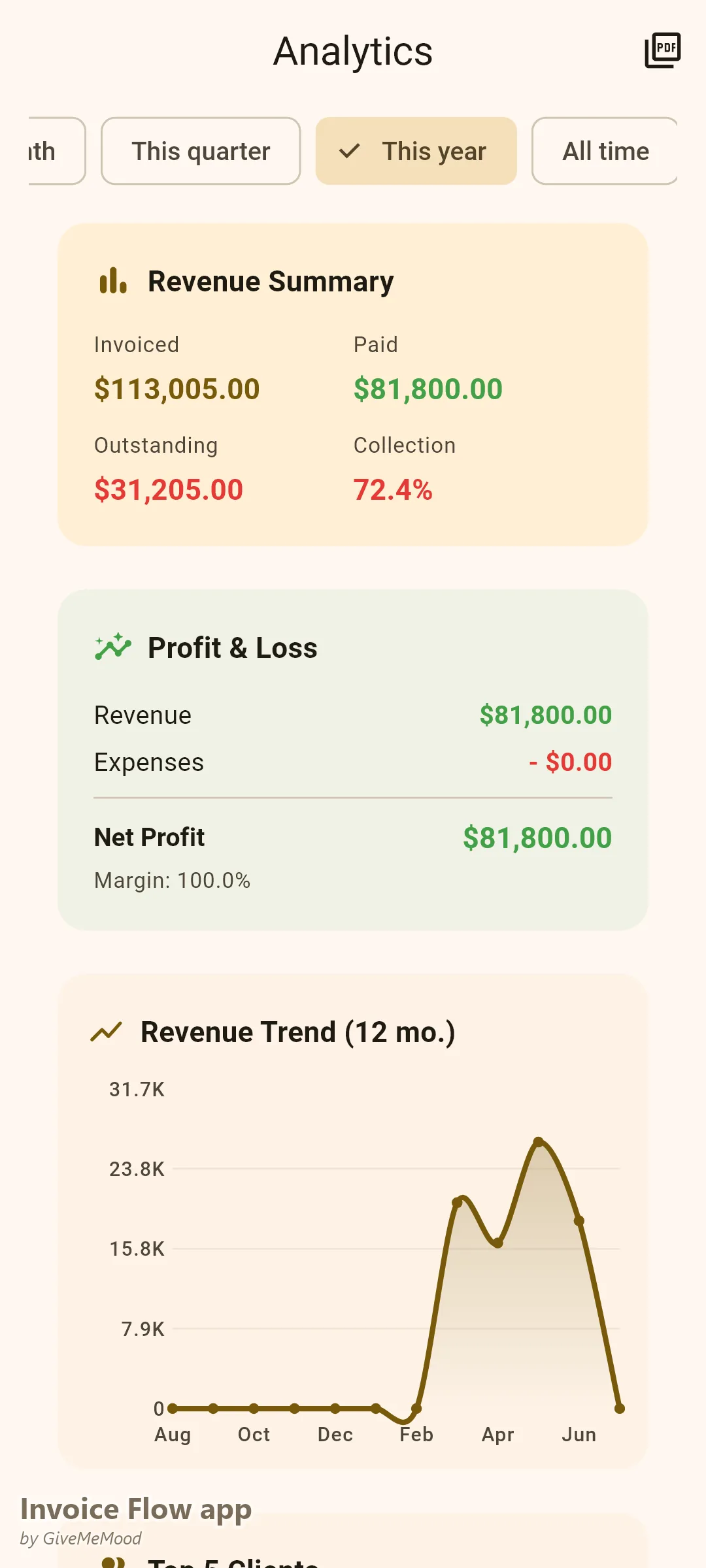
The billing category that has made the biggest difference to my practice income is supplemental services — work that falls outside the original scope of services defined in the contract.
Before I had professional invoicing, I handled out-of-scope requests informally. A client would ask for a redesign of the kitchen beyond what was in the original scope. I would do it. I would tell myself I would figure out the billing later. Often “later” never came, or came in the form of an awkward conversation that I tried to resolve by absorbing the cost.
After InvoiceFlow, my supplemental service billing is immediate and professional:
“Supplemental Services Authorization — [Client Name] — March 2026: Service: Revised kitchen layout design — client-requested change from original approved layout. New layout requires revision to structural drawings and kitchen fixture coordination. Work not included in original contract scope. Estimated hours: 14 hours × $185/hour: $2,590. Authorization required before work commences. Supplemental services billed at commencement and completion of work.”
The supplemental service invoice includes a place for the client to sign authorizing the work before it begins. Since I started using this format, I have received authorization for every supplemental service I have proposed. Clients appreciate the clarity — they know exactly what additional work will cost before I do it. And I am compensated for work that previously disappeared into the project.
The Corporate Client That Changed My Practice
About three years into my practice, I won a commission from a real estate development company to design a mixed-use building — commercial ground floor, residential units above. This was my first corporate client.
Corporate clients have specific billing requirements that residential clients do not. They need formal invoices with project codes and reference numbers. They need net-30 payment terms. They need billing that aligns with their project accounting system. And they need supporting documentation — my letter of contract, my fee schedule, the specific phase milestones — to satisfy their procurement and legal departments.
My InvoiceFlow billing was already professional enough to meet most of these requirements. The main adjustments were adding their project reference code to each invoice and confirming net-30 terms.
The corporate client paid reliably, on terms, without discussion. Three phase invoices, each for a significant amount, each processed and paid within 28 days of issuance. The contract was $95,000 in design fees across six phases.
That corporate client has referred me to two other development companies. I now have a consistent pipeline of commercial work that I would not have won without professional billing infrastructure.
What the Practice Looks Like Five Years In
Chen Architecture is a two-person practice — myself and a junior designer — with a consistent mix of residential and commercial work. Our billing is entirely phase-based, with supplemental service documentation for any out-of-scope requests and monthly reimbursable statements attached to all active projects.
Cash flow is predictable. We know when phase invoices are coming in based on project milestones. We track outstanding balances by project. We know exactly what our pipeline of expected income looks like.
The practice that almost ran out of money in its first year is now fully solvent, growing, and financially organized in a way I could not have imagined in 2021.
The lesson was expensive but important: architecture is a long-timeline business. Billing needs to match the timeline. Phase-based billing is not just a preference — it is financial survival.
Download InvoiceFlow. Build your phase billing templates. Issue your first phase invoice at project commencement, not three months in. Your practice will be healthier for it.
Robert Chen, AIA, is the principal of Chen Architecture in Boston, Massachusetts, specializing in residential additions, mixed-use commercial development, and institutional projects in the greater Boston area.