 EN
EN  العربية
  Български
  Čeština
  Dansk
Dansk  Deutsch
  Ελληνικά
  Español
  Suomi
Suomi  Français
  עברית
עברית  हिन्दी
  Bahasa Indonesia
  Italiano
  日本語
日本語  한국어
한국어  Bahasa Melayu
  Nederlands
  Norsk
Norsk  Polski
  Português
  Română
  Русский
  Svenska
  Kiswahili
  ไทย
ไทย  Türkçe
  Українська
  Tiếng Việt
  中文
中文 From Weekend Chaos to Organized Operations: How I Fixed the Billing Hole in My Rental Business
By Derek Santos, Owner — Santos Event Rentals, Phoenix, AZ
A rental business sounds simple from the outside. You own things. People pay to borrow them. They give them back. You do it again.
What they do not tell you is that a rental business without a deposit system is essentially a lending library that runs on trust — and that trust costs you money every single week.
I started Santos Event Rentals seven years ago with a pickup truck, a cargo trailer, forty round tables, four hundred chairs, and linens I bought at a liquidation auction. By the end of year two, I had tripled my inventory. By year five, I had two vans, a warehouse, staff for weekends, and a client list that included wedding venues, event coordinators, corporate event teams, and private families celebrating everything from quinceañeras to retirement parties.
The business was growing. The billing problem was growing with it.
The Memorial Day Weekend That Broke My System
In my third year, I had a single weekend that exposed every flaw in my approach to deposits and documentation.
Memorial Day weekend. I had six events booked simultaneously: two weddings on Saturday, a corporate picnic on Sunday, two private parties on Monday, and a graduation party that overlapped with the Sunday corporate event. I had equipment reserved for all six. I had delivery routes planned. Staff scheduled.
Thursday morning, two hours before I needed to start loading the first delivery, one of the Saturday weddings cancelled. It was a family situation — I understood, I genuinely did — but they had given me no deposit, so I had nothing to retain. The equipment I had reserved for them — sixty chairs, six tables, linens, a tent section — sat in my warehouse that weekend while I had turned away two other Saturday inquiries to hold it for them.
Three hours later, the corporate picnic contact called to say their event had been moved to a smaller venue and they needed to reduce the order significantly. Again, no deposit. The change was entirely at their discretion.
By Friday evening, I had absorbed two significant revenue losses and was stressed about the remaining four deliveries, which all went smoothly. The weekend that should have been my best of the year was instead a painful lesson in what happens when you run a high-logistics, time-sensitive business on informal agreements.
The Deposit Structure That Stopped the Losses
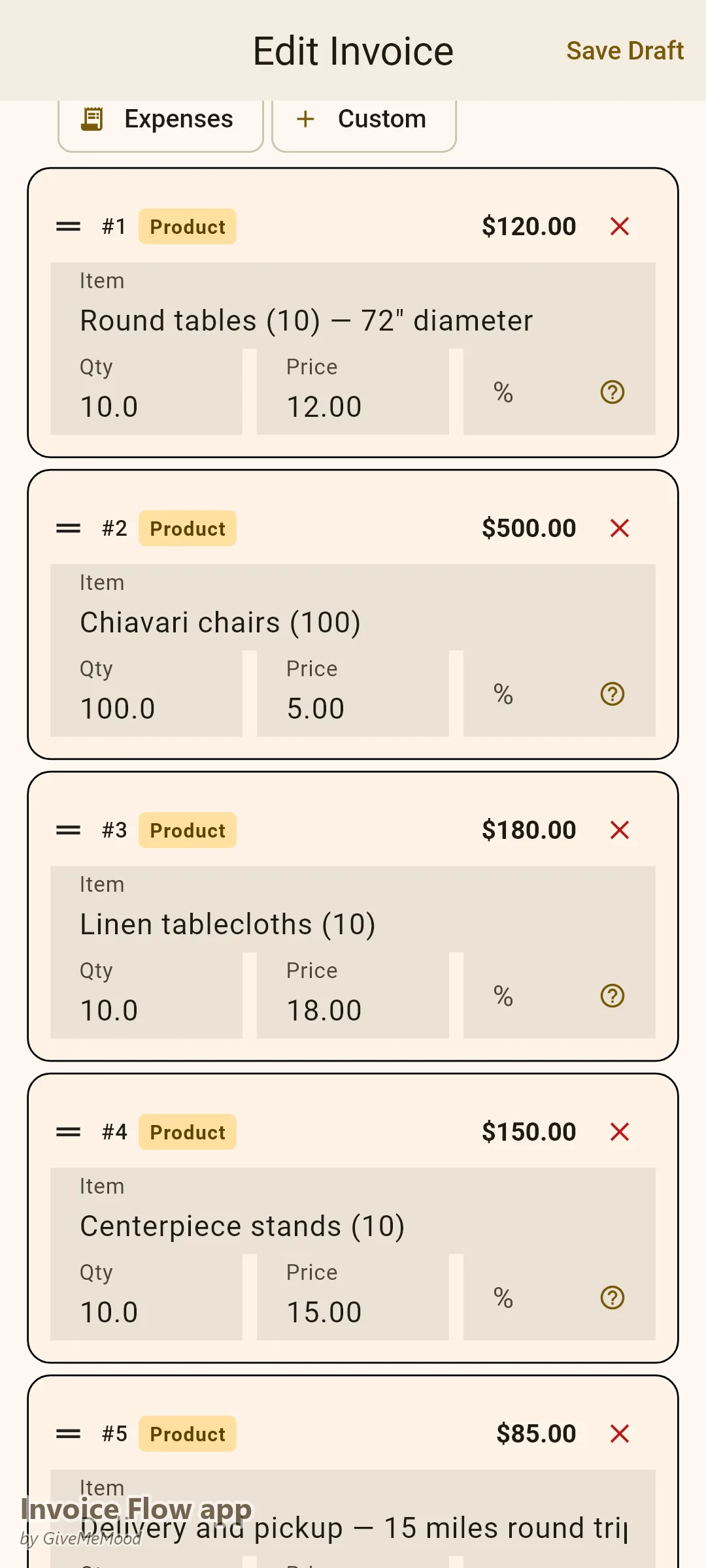
I set up InvoiceFlow the following Monday and spent most of that week rebuilding my intake process.
The new policy was simple: no equipment is reserved without a deposit invoice, and no equipment leaves the warehouse without the balance being paid. Every booking starts with an invoice.
The deposit structure I settled on:
Standard bookings (under $500 total): 50% deposit at booking, balance due 7 days before the event.
Mid-range bookings ($500-$2,000): 30% deposit at booking, balance due 14 days before the event.
Large bookings (over $2,000, including corporate): 25% deposit at booking, balance due 21 days before the event.
The first week I sent deposit invoices instead of verbal confirmations, four out of seven inquiries completed the deposit immediately. Two said they needed to think about it. One said they would find someone who did not require a deposit. That last call — which would have previously made me anxious — was actually clarifying. That is not the client I want. A client who will not commit $100 to hold $300 worth of equipment is a client who will cancel the day before.
The Multi-Item Invoice That Saved Hours
Before InvoiceFlow, I built my invoices manually every time — pulling up a previous PDF, editing the line items, saving a new version. For a simple order, this took ten to fifteen minutes. For a complex wedding rental with fifty line items, it could take forty-five minutes to an hour.
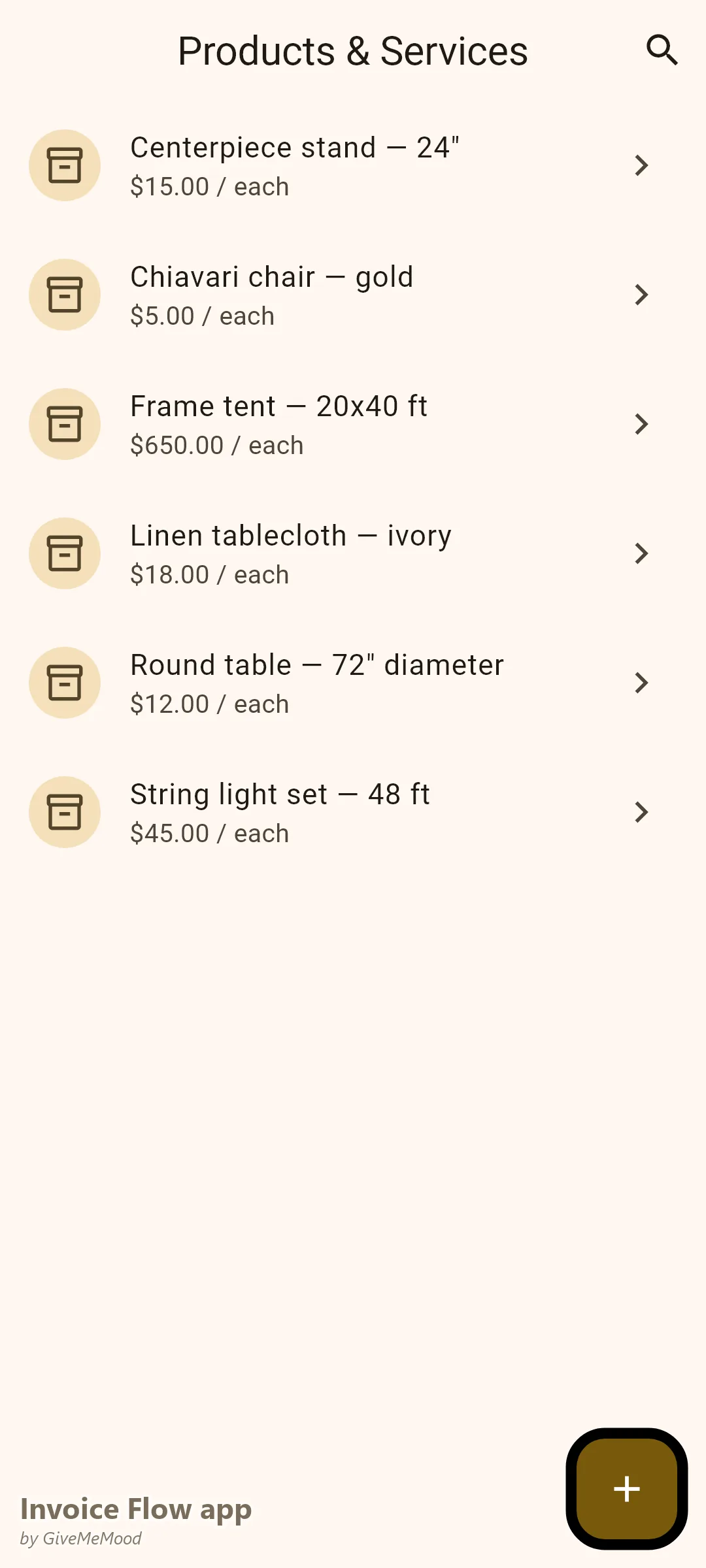
With InvoiceFlow’s product library, I entered every item in my rental catalog once. Tables, chairs, linens, tents, dance floors, staging, AV equipment, barware, serving equipment — each with its standard rental rate. Now building an invoice is a matter of entering quantities. A complex wedding rental that used to take an hour takes eight minutes.
More importantly, the invoices are accurate. When I was building invoices manually by editing old PDFs, items would occasionally be priced incorrectly or listed under the wrong quantity. Billing disputes after events were not common, but they happened enough that I dreaded them. With the product library, every item pulls in at its standard price. The math is done automatically. There is nothing to dispute.
Damage Deposits: The Most Important Separate Invoice
One of the specific billing improvements that has made the most difference is the formal damage deposit invoice.
Previously, I collected damage deposits informally — sometimes in cash, sometimes folded into the total rental payment, sometimes forgotten entirely. When equipment came back damaged, I had no clear documented record of what deposit I had collected, what the damage was worth, and what the client had agreed to. Conversations about damaged equipment were always uncomfortable and occasionally became arguments.
Now the damage deposit is a separate, formal invoice: “Security Deposit — Equipment Rental — [Event Name] — Refundable upon undamaged return of all equipment: $[Amount].”
The damage deposit invoice is issued at the same time as the rental invoice but must be paid separately. After the equipment is returned and inspected, one of three things happens: the deposit is refunded in full, a partial amount is retained for documented damage, or the full amount is retained for significant damage. In every case, I have the original invoice as documentation.
I have had to retain damage deposits four times in the past three years. In all four cases, the documented deposit invoice made the conversation straightforward. The client had agreed to the terms in writing. The equipment damage was photographed. The retained amount was applied to the documented cost of repair or replacement.
None of the four became disputes. All four would have become disputes without the documentation.
Corporate Events: The Account That Changed My Business
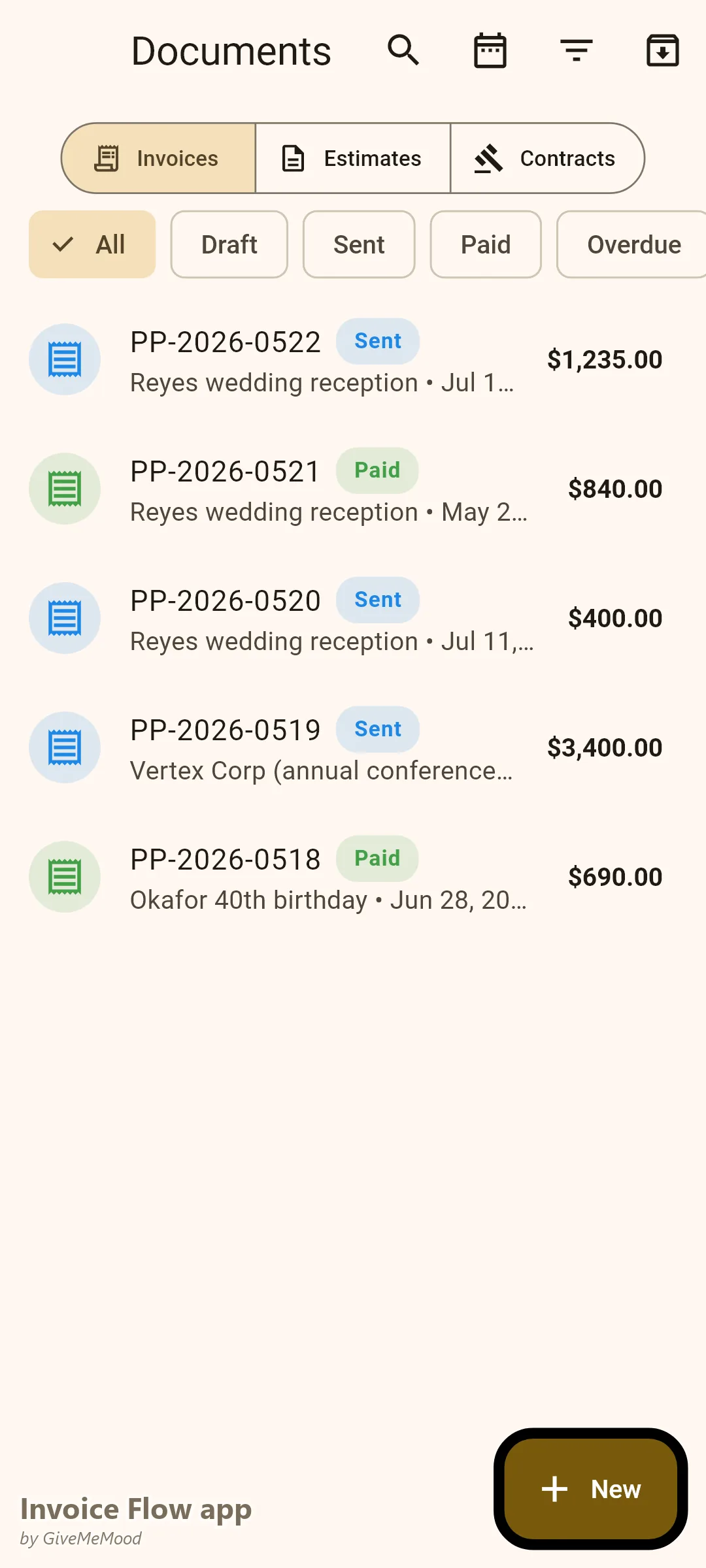
About four years in, I started getting inquiries from corporate event coordinators at companies around Phoenix. Tech companies, real estate firms, financial services companies, healthcare organizations — they all run events. They all need equipment. And they all, without exception, require formal invoices.
The first corporate inquiry I handled professionally was from a technology company hosting an annual all-hands meeting outdoors at their campus — 350 employees, picnic tables, lawn chairs, canopies, serving equipment, trash and recycling stations. The event coordinator told me they needed an invoice with their vendor number, the event date, a project reference code, and net-30 terms.
I built that invoice in InvoiceFlow in about twelve minutes. It had every field they needed:
“Corporate Event Equipment Rental — All-Hands Annual Meeting, May 15, 2026:
- Folding Tables 6ft (40): $480
- Folding Chairs (350): $700
- Canopy Tents 10×10 (8): $1,200
- Picnic Table Sets (10): $400
- Serving Tables (6): $90
- Trash/Recycling Stations (12): $240
- Delivery, Setup and Pickup — Mesa Corporate Campus: $350 Total: $3,460. Vendor Number: [THEIR CODE]. Event Reference: [THEIR CODE]. Net-30.”
They processed it through accounts payable. Payment arrived on day 22. The event coordinator recommended me to two colleagues at partner companies. I now have seven corporate accounts in Phoenix.
Corporate accounts are the most reliable income I have. They plan in advance. They pay on terms. They repeat. They refer. The total revenue from corporate accounts has grown from zero to approximately 38% of my annual revenue in three years.
The Income View That Changed My Inventory Decisions
When I started tracking revenue by category through InvoiceFlow’s analytics, I discovered something I should have known but did not: my tent and canopy rental was generating a disproportionate share of my revenue relative to the warehouse space it occupied. Tables and chairs are high-volume but lower-margin. Tents are lower-volume but higher-margin, and corporate clients specifically request them.
I expanded my tent inventory based on this data — from eight canopies to twenty, and I added three larger frame tents. The investment paid back within one summer season.
I would not have made that decision without the category-level revenue data. I was making inventory decisions on gut feel. The analytics replaced gut feel with actual numbers.
What the Business Looks Like Now
Santos Event Rentals today has two full-time drivers, four part-time weekend staff, a warehouse with organized inventory, and a client base that includes wedding venues, corporate event teams, professional event coordinators, and private families. Every booking has a deposit invoice. Every event has a balance invoice. Every rental has a damage deposit invoice. Every corporate client has a net-30 formal invoice.
Cancellations have dropped dramatically. Billing disputes are nearly nonexistent. The Memorial Day weekend chaos that used to define my peak season is now just peak season — busy, but organized.
The business I built on forty tables and four hundred chairs now runs on the same equipment philosophy: everything has a place, everything is tracked, and nothing goes out without documentation.
Download InvoiceFlow. Build your rental catalog. Send the first deposit invoice on your next booking. Stop operating a lending library. Run a business.
Derek Santos is the owner of Santos Event Rentals in Phoenix, Arizona, serving weddings, corporate events, and private celebrations across the greater Phoenix metropolitan area.