 EN
EN  العربية
  Български
  Čeština
  Dansk
Dansk  Deutsch
  Ελληνικά
  Español
  Suomi
Suomi  Français
  עברית
עברית  हिन्दी
  Bahasa Indonesia
  Italiano
  日本語
日本語  한국어
한국어  Bahasa Melayu
  Nederlands
  Norsk
Norsk  Polski
  Português
  Română
  Русский
  Svenska
  Kiswahili
  ไทย
ไทย  Türkçe
  Українська
  Tiếng Việt
  中文
中文 How I Scaled My Organic Farm From CSA Chaos to Professional Wholesale Billing
By Rachel Green, Owner — Verdant Organics, Craftsbury, VT
When I started Verdant Organics eleven years ago, I imagined a simple business: grow certified organic vegetables, sell them directly to people who care about where their food comes from, build something sustainable. In the early years, that simplicity was real. I had 30 CSA members. They paid by check at the start of the season. I dropped off boxes every Thursday. My bookkeeping was a handwritten ledger I updated on Sunday evenings.
By year four, I had 85 CSA members. By year seven, 140. I had two natural food store wholesale accounts and three restaurant relationships. What had been a simple financial picture was now genuinely complicated — and my Sunday evening ledger was no longer adequate.
The specific problem was not that I did not know what money was coming in. The problem was that I could not demonstrate it professionally, and that gap was costing me business.
The Natural Food Store Problem
My first natural food store account started in my third year. A co-op about thirty minutes from the farm had heard about my mixed greens and specialty tomato varieties from one of their member-suppliers and reached out about a weekly delivery arrangement.
The relationship started well. The produce was good. The store’s members bought everything I brought. But within the first three months, I started getting calls from the store’s receiving manager with questions about my invoices.
My invoices at the time were spreadsheets I printed and drove in with the produce. They had the items, weights, and prices. They did not have my USDA certified organic certification number. They did not have the lot reference numbers that the store’s traceability system required. They did not have a consistent invoice number. They did not have my vendor ID in their system.
Every invoice that was missing one of these elements got flagged and held in their accounts payable queue until I sent a correction. My average payment time on that account was 52 days. Their stated payment terms were net-21.
The gap between 21 and 52 days was entirely the result of documentation I was not providing.
The second natural food store I approached — a larger regional co-op — actually declined to work with me initially because I could not demonstrate that I had a formal invoicing system. The buyer told me directly: “We’ve had issues with small farms before where the documentation doesn’t match our requirements and we end up in payment disputes. Until your invoicing is formalized, we can’t bring you on as a vendor.”
I went home that afternoon and started looking for an invoice app.
What Organic Produce Billing Actually Requires
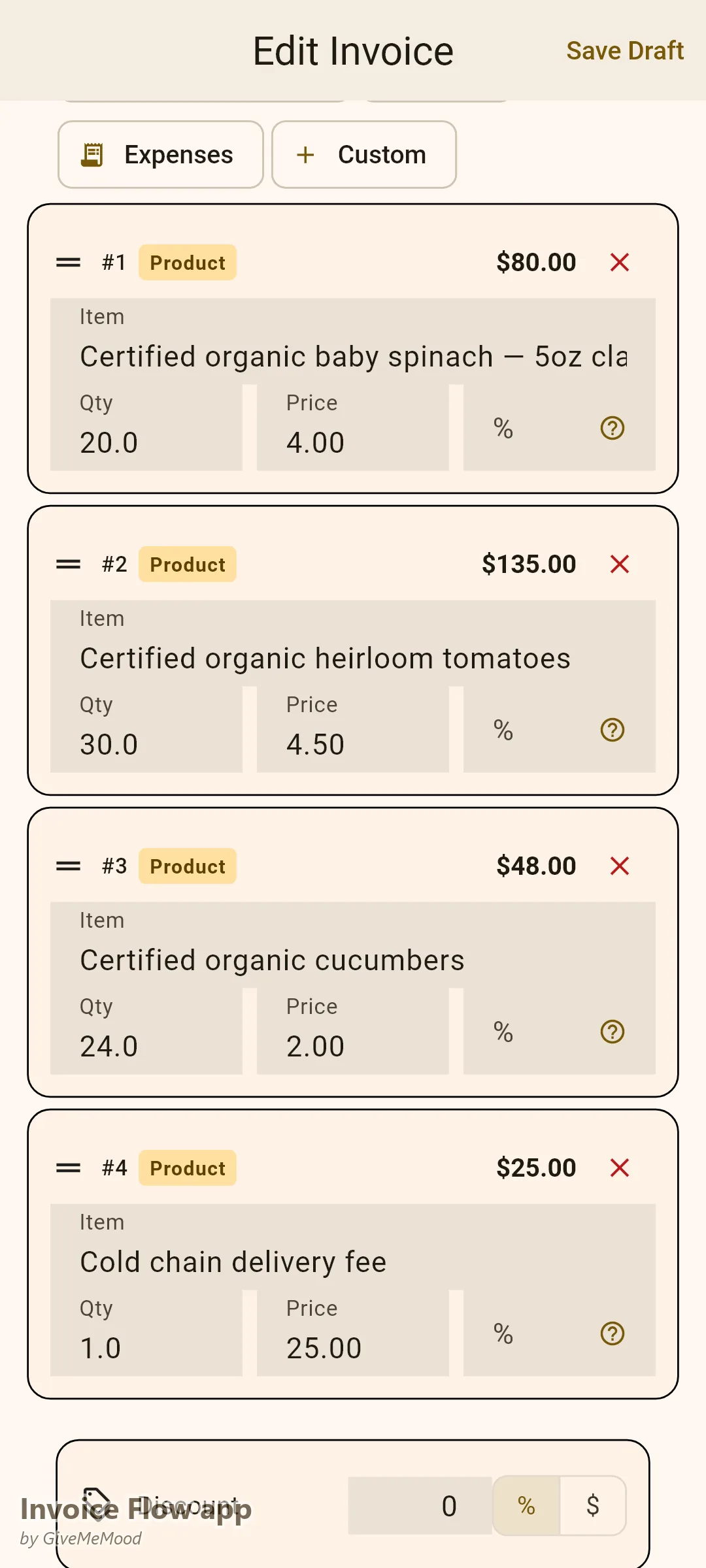
Before I found InvoiceFlow, I needed to understand what I actually had to put on an invoice to meet the requirements of professional buyers. After conversations with the co-op buyer and some research, the list looked like this:
USDA NOP certification number. This goes on every invoice for certified organic produce. Buyers need it for their own traceability records and for any certifying audit they undergo.
Lot numbers. For produce, a lot number ties a delivery to a specific planting or harvest batch. If there is ever a food safety question, the buyer can trace exactly which lot was involved. Restaurants and natural food stores take this seriously.
Vendor ID. Every wholesale buyer has a vendor management system. Your invoice needs to match your vendor registration in their system, or it goes into a manual reconciliation queue.
Net payment terms stated explicitly. “Net-21” or “Net-30” needs to be on the invoice. An invoice without stated payment terms is an invoice with no implied deadline.
Invoice number. Sequential invoice numbers let buyers file and retrieve invoices, and they let you track which invoices have been paid.
None of this is unreasonable. All of it is standard. None of it was on my spreadsheets.
Setting Up InvoiceFlow for a Certified Organic Farm
I downloaded InvoiceFlow and spent about two hours setting up my business. What struck me immediately was the ability to add custom fields to invoices — this was exactly what I needed for certification numbers and lot references.
I set up my produce items: Certified Organic Mixed Greens, Certified Organic Heirloom Tomatoes (Cherokee Purple, Black Krim, Brandywine), Certified Organic Baby Carrots, Certified Organic Shishito Peppers. For each, I had a unit of measure (pounds, bunches, or units) and a standard price.
I set up a weekly CSA share item at two price points: Full Share and Half Share. I set up seasonal prepayment invoice templates for both.
For the wholesale invoices, I added custom fields: Organic Certification No., Lot Reference, Vendor ID. Every wholesale invoice now has these fields filled in before the produce leaves the farm.
CSA Billing: The Automation That Changed My Summers
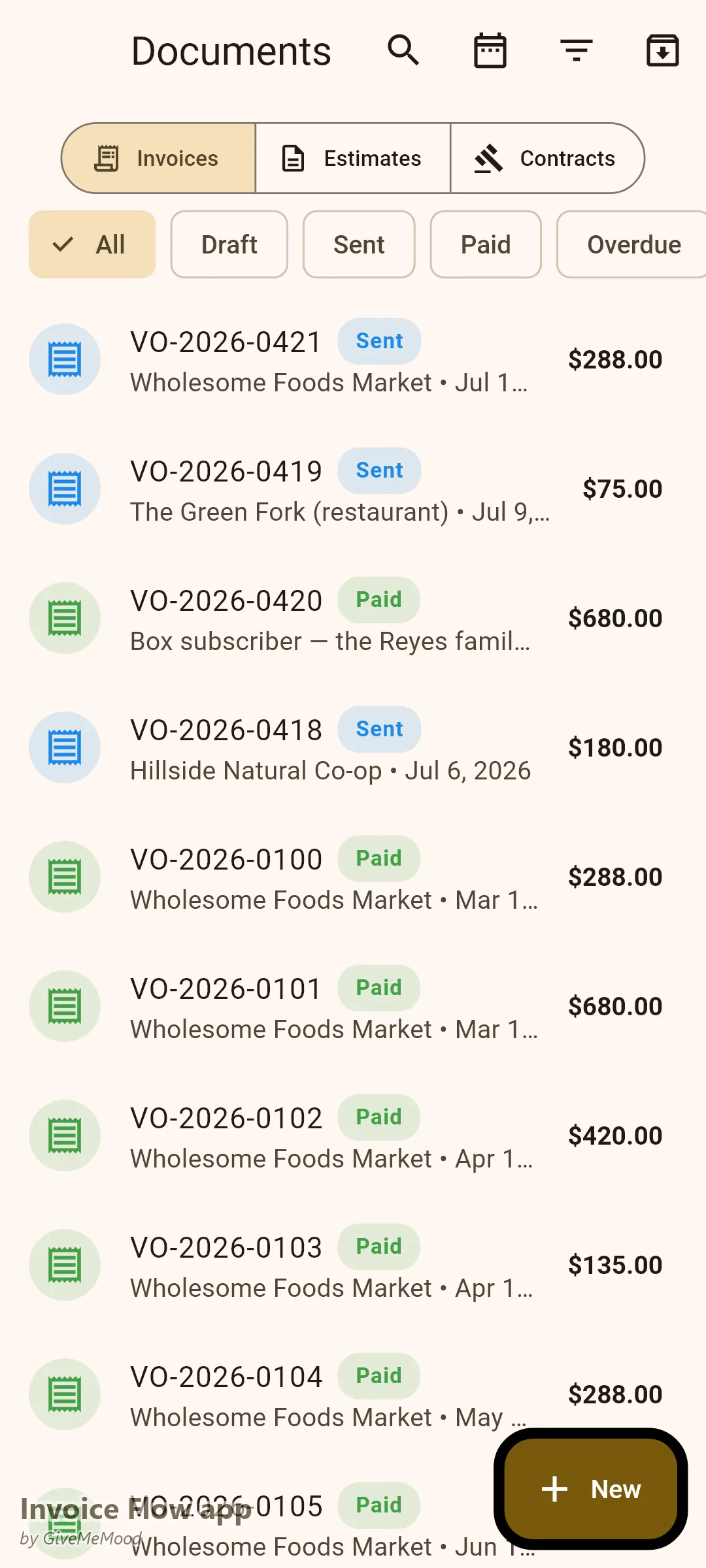
140 CSA members. Weekly shares from June through October. For seven years, billing these members was a significant part of my weekly administrative work. I had people who paid by check, people who used Venmo, people who forgot to pay and needed reminders, people whose checks bounced, people who wanted to add shares or subtract shares or suspend for vacation weeks.
The first summer I used InvoiceFlow for CSA billing, I configured recurring invoices for each member. Weekly share invoices went out automatically each Monday morning. Members received their invoice, paid through the payment link, and the transaction was recorded.
The change to my administrative time was dramatic. What had been four to five hours per week of payment tracking — reconciling checks, sending Venmo reminders, updating the ledger — became about thirty minutes. I checked the unpaid invoice list on Thursday before deliveries and sent one-click reminders to anyone with an outstanding balance.
Late payment rates dropped. Not because my members were suddenly more reliable — the same members who were always prompt continued to be prompt. But the members who sometimes forgot now had a consistent, professional invoice arriving on Monday morning with a payment link that took thirty seconds to use. The friction of paying had been reduced to almost nothing.
I also implemented seasonal prepayment invoices for members who preferred to pay upfront: “2026 Summer Season — Full CSA Share, 22 weeks, June through October: $616.” Forty-two percent of my current members now pay at season start. This gives me over $25,000 in operating capital before the first seed goes in the ground.
Restaurant Billing: Traceability That Chefs Actually Value
My three restaurant accounts are different from the natural food stores in one important way: the chefs are deeply interested in the traceability documentation.
The chef at the farm-to-table restaurant that buys most of my heirloom tomatoes told me that he wants to be able to tell his guests — and his team — exactly where the food comes from, down to the harvest batch. He wants to be able to pull up a lot number and know which field, which planting, which week.
My restaurant delivery invoices now include that information: “Certified Organic Heirloom Tomatoes — Cherokee Purple, Lot CPC-2026-0614 — 20 lbs @ $5.50/lb: $110. Certification: USDA NOP #VT-22-01847.” The chef files this invoice in his kitchen records system. When he writes “Cherokee Purple, Lot CPC-2026-0614” on the menu or in the team prep notes, he has the documentation to back it up.
This level of documentation has become a competitive differentiator. I know of two other vegetable farms in the area that could theoretically supply this restaurant. But they cannot provide the traceability documentation the chef wants. I can. My wholesale relationship with this restaurant has continued for four seasons.
What Income Tracking Revealed
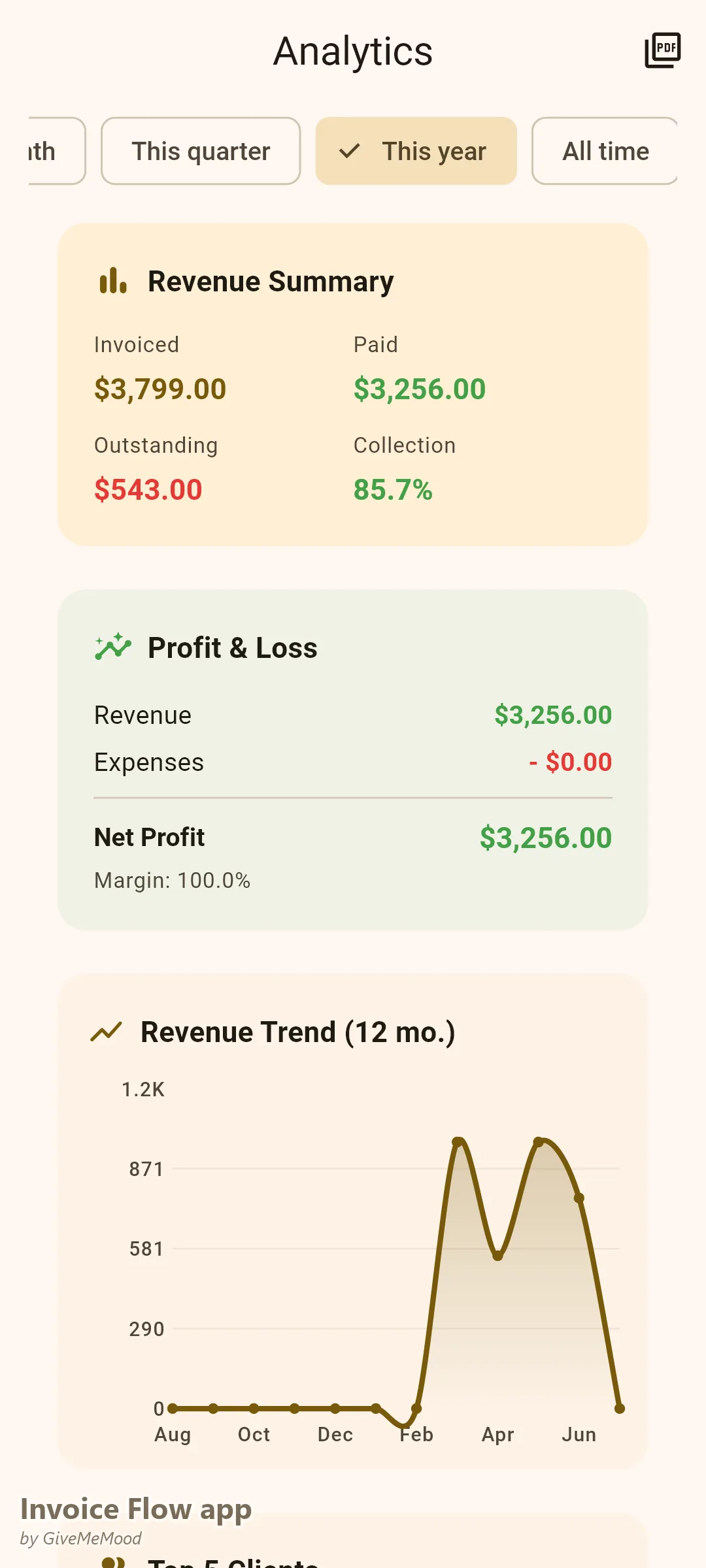
One of the unexpected benefits of switching to professional invoicing was the income analytics. After two full seasons of data, I could see clearly how my revenue was distributed across channels.
The breakdown surprised me: CSA subscriptions represented 38% of revenue. Restaurant accounts were 31%. Natural food store wholesale was 22%. Farmers market was 9%.
I had always thought of my CSA as the core revenue pillar of the farm — the thing the whole business was built around. And it is important. But it is not as dominant as I had assumed. The restaurant relationships I had built more recently were generating nearly as much revenue, and the natural food store accounts — which felt like the most “paperwork-intensive” part of the business — were generating 22% of revenue on a consistent weekly basis.
This visibility changed how I thought about next season’s growth. I now know that adding one more restaurant account is worth more than adding twelve more CSA members. I know which channel to prioritize when I have limited growing capacity. I could not have made this analysis before — the data simply did not exist in a form I could see.
The Second Natural Food Store
Six months after I started using InvoiceFlow, I went back to the regional co-op that had declined to work with me. I showed them a sample invoice: certification number, lot references, their vendor ID field, net-21 payment terms, sequential invoice number. They approved me as a vendor within the week.
My average payment time at that account is now 19 days. Their payment terms are net-21. That is what happens when you give buyers documentation they can process on first review.
What My Farm Looks Like in Year Eleven
My CSA is stable at 140 members. My natural food store accounts have stabilized at three. My restaurant relationships have grown to five. My farmers market presence continues. And my Sunday evenings are no longer spent on billing reconciliation.
I did not change the quality of what I grow to get to this point. The vegetables were always good. What changed was the documentation that surrounds them — the professional evidence that a serious business is behind this produce. For buyers who need that documentation to do their jobs properly, it made all the difference.
For organic farmers who are approaching wholesale accounts or trying to scale their CSA: get the billing right first. The conversation with a co-op buyer or a restaurant purchasing manager goes differently when you can show them a professional invoice template. You are not just a good farmer. You are a vendor they can rely on.
Rachel Green is the owner of Verdant Organics, a certified USDA organic vegetable farm in Craftsbury, Vermont, operating since 2015 with CSA subscriptions, restaurant accounts, and natural food cooperative wholesale.