Cash Flow for the Self-Employed: Building an Invoicing Rhythm That Keeps You Solvent
By the InvoiceFlow team — published 16 June 2026 — 11 minute read
Profit is an opinion. Cash is a fact. You can have a booked-out quarter, a fat order book, and a spreadsheet full of "won" deals, and still not be able to pay your own rent — because profit is what you'll eventually earn, while cash is what's in the account today. The graveyard of self-employment is full of people who were profitable on paper and insolvent in practice. They didn't run out of work. They ran out of timing.
The fix is not working harder or charging more. It's rhythm — a deliberate, repeatable cadence of invoicing, terms, and follow-up that keeps money flowing in at a pace that matches the money flowing out. Most cash-flow crises among the self-employed aren't pricing problems; they're timing problems, and timing is exactly what a good invoicing rhythm controls. This is how to build one.
The gap that kills you: work done vs cash in
Every self-employed person lives inside a gap. On one side is the day you finish the work. On the other is the day the money actually lands in your account. That gap is filled with delays you don't always control: how long until you invoice, the payment terms you offered, how long the client sits on it, and how long it takes you to notice and chase if they don't pay.
Each of those is a lever. Add them up and you get your real cash cycle — and it's almost always longer than people think. A "net 30" invoice you send a week after finishing, to a client who pays a week late, isn't a 30-day wait. It's 7 + 30 + 7 = 44 days from finishing the work to seeing the cash. Do that on a job that cost you money to deliver, with no deposit, and you've financed your client's business for a month and a half out of your own pocket.
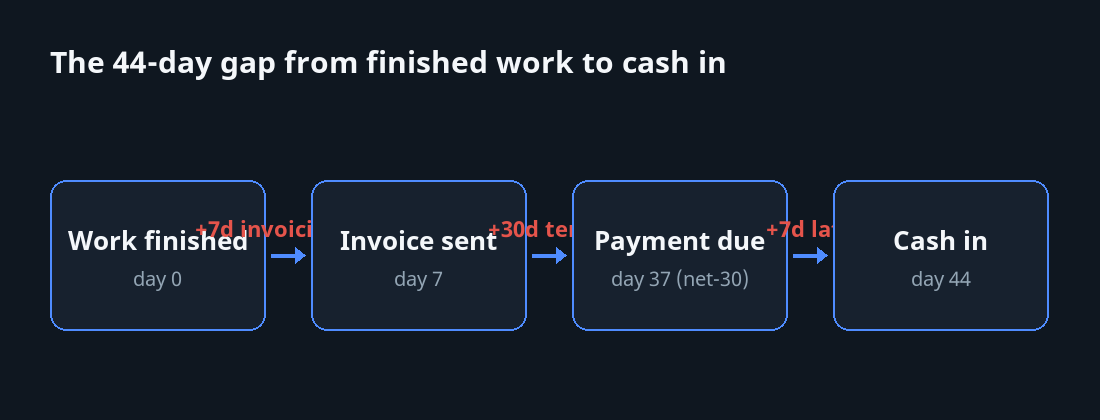
The whole discipline of cash-flow rhythm is about shrinking and controlling that gap on purpose, lever by lever.
Lever 1: Invoice promptly — the cheapest cash-flow win there is
The single most common, most fixable cash-flow mistake is the lag between finishing work and sending the invoice. "I'll do the invoices at the end of the month" feels organized. It's actually a self-imposed delay that can add weeks to every payment, for free, costing you nothing to eliminate.
The rule is simple: invoice the moment the work is done, ideally the same day. The job is freshest in the client's mind, your motivation is highest, and the clock on your payment terms starts immediately rather than three weeks later. If you finish on the 3rd and invoice on the 3rd with net-14 terms, you can expect cash by the 17th. Finish on the 3rd, invoice on the 30th, and you've voluntarily pushed payment into the next month.
This is where having invoicing in your pocket matters. With InvoiceFlow you can build and send a professional invoice from your phone right after the job — by email through built-in SMTP, or via the system share sheet — so "I'll do it later" never gets the chance to become "I forgot." Same-day invoicing is the highest-return habit in this entire article, and it costs nothing but the decision to do it.
Lever 2: Set terms — and make them shorter
Your payment terms are a number you choose, not a law of nature. "Net 30" became a default for big-company accounts-payable departments; there is no rule that a freelancer or small shop must offer it. For most self-employed work, net 7 or net 14 is entirely reasonable, and shaving two weeks off your terms shaves two weeks off your cash cycle on every single invoice you ever send.
Put the terms in writing on the invoice itself — a clear due date, not a vague "payable on receipt." A specific date ("Due 30 June") gets paid faster than a fuzzy instruction, because it removes the client's discretion about what "soon" means. And back the terms with consequences: a stated late-fee policy turns your due date from a suggestion into a boundary. In InvoiceFlow you can run a full late-fee subsystem — flat, percentage, or per-day-style charges, applied only to eligible sent or overdue invoices (never drafts) — so the cost of paying late is real and automatic rather than a threat you have to make awkwardly by email.
Lever 3: Take deposits — get paid before you're exposed
A deposit is the most powerful cash-flow tool the self-employed have, and it's astonishing how many leave it on the table. A deposit does two things at once: it funds the start of the work so you're not financing the project yourself, and it commits the client, filtering out the ones who were never serious.
For most project work, ask for 30% to 50% up front, with the balance on delivery or at milestones. You issue one invoice for the full amount, record the deposit as a payment, and the app tracks the remaining amount due — total minus what's been received — so you always know exactly what's still owed without a parallel spreadsheet. The deposit means that even if a client vanishes mid-project, you're not out of pocket for work already done. It moves cash to the front of the cycle, where it does you the most good.
Lever 4: Bill by milestone on long work
The longer a project runs, the more dangerous a single end-of-project invoice becomes. Three months of work billed in one lump at the end means three months of financing the client, and one catastrophic exposure if it goes wrong. Milestone billing breaks the engagement into stages, each with its own payment, so cash arrives throughout the work rather than all at the dangerous end.
A web project might bill 30% on signing, 40% at a staging milestone, and 30% at launch. You can express this two ways in InvoiceFlow: as a split payment schedule on a single invoice (the installment template renders the plan cleanly on the PDF), or by using Projects and Milestones to group the work and bill each milestone as it's reached. Either way, the principle holds — money in along the way keeps you solvent through a long engagement instead of betting your quarter on one final payment.
Lever 5: Build recurring revenue — the cash you can predict
Project income is lumpy: feast, famine, feast. The antidote is recurring revenue — retainers, subscriptions, maintenance plans, memberships — money that arrives on a predictable cadence whether or not you closed a new deal this week. Even a modest base of recurring income transforms cash-flow planning, because it gives you a floor you can count on under the lumpy project work on top.
The catch is that recurring billing is exactly the kind of repetitive admin people forget. This is what recurring schedules are for: in InvoiceFlow you set up a schedule for a retainer or subscription and it auto-generates the invoices on the cadence you choose, with correct sequential numbering, so a client who pays you €400 a month gets a clean, correctly-numbered invoice every month without you remembering to make one. Predictable revenue only helps your cash flow if it actually gets billed; automating the recurring invoice is how you make sure it does.
Lever 6: Track outstanding and overdue — see the gap before it bites
The five levers above push cash toward the front of the cycle. The sixth is about visibility — because you can't manage a cash gap you can't see. At any moment you should be able to answer three questions instantly: How much is owed to me in total? Which invoices are overdue? Which clients owe me the most?
This is where the app earns its keep as a cockpit rather than a filing cabinet. The Analytics dashboard shows revenue, paid versus outstanding, and your collection rate — the proportion of what you've billed that you've actually collected — along with your top clients and trends. A collection rate quietly drifting below 100% is the earliest warning sign of a cash-flow problem, long before your bank balance tells you.
The AI Assistant makes this even faster. It is not a chatbot and it does not write content for you — it's an insights assistant that answers preset commands against your own data. Ask it for a revenue summary, your overdue invoices, your top 5 clients, or your monthly stats, and it surfaces the numbers instantly. Used as part of a weekly routine — "show me overdue invoices" every Monday — it turns cash-flow tracking from a quarterly panic into a five-minute habit.
Chase the right invoices, on time
Seeing what's overdue is only useful if you act on it. Build a follow-up into the rhythm: a polite reminder the day an invoice goes overdue, a firmer one a week later, and a late fee applied if it keeps slipping. The point isn't to be aggressive — it's to be consistent, so clients learn that your due dates are real. Consistency, not aggression, is what gets you paid on time.
Putting it together: a worked rhythm
Here's how the levers combine for Anna, a freelance UX designer in Riga who used to lurch from flush to broke and back. She rebuilt her business around a rhythm:
- Deposits up front. Every project starts with a 40% deposit, invoiced and recorded before she opens a file. That alone funds her month-to-month.
- Net-14 terms with a due date and a late-fee policy. Half the cash cycle of her old net-30 invoices, with a real consequence behind the deadline.
- Same-day invoicing. She invoices from her phone the moment a milestone is signed off, never "at month-end."
- Two retainer clients on recurring schedules. €1,200 a month lands automatically — a floor under the lumpy project income.
- A Monday five-minute check. She asks the AI Assistant for overdue invoices and a revenue summary, sends any reminders, and gets on with her week.
Same skills, same rates, same clients. The only thing that changed was the timing — and the timing is what made her solvent. She stopped financing her clients and started running a business that pays her on a schedule she controls.
The wider point
Cash flow isn't a finance topic you can safely ignore until tax season. For the self-employed it's the difference between a business that survives a slow month and one that doesn't. And the controls are almost entirely within your reach: when you invoice, what terms you set, whether you take a deposit, how you stage long work, whether you build a recurring floor, and how closely you watch what's outstanding.
None of it requires a finance degree or a payment processor. It requires a rhythm — invoice promptly, set short clear terms, take deposits, bill by milestone, build recurring revenue, and watch your outstanding and overdue every week. Build that cadence once and let the tools keep it running, and the gap between work done and cash in stops being the thing that can quietly sink you.